The war machine springs to life over Syria

Update: Three hours after the initial posting of this report, the US, the UK and France conducted a missile air strike against Syria

The events of the past few days involving Syria, the US and Russia are highly concerning.

Currently, the US is busy readying to drop just dropped ~120 missiles on Syria to punish it for an alleged poison gas attack on its civilians. I say "alleged" because no on-the-ground investigation has been conducted.

At this point, we don't really know with confidence what was done by whom. But America's war machine is straining hard against it's chain, eager to strike. And this poison gas atrocity may just be the excuse the West needs to unleash it.

Whodunit?

We do know that Syria at one time indeed had stockpiles of chemical weapons. But they handed them over to international inspectors some years back. Could they have kept some stocks hidden? Sure.

But we also know that the rebel jihadists in Syria have been caught making and using chemical weapons many times in the recent past. Russia has repeatedly brought forth evidence of chemical manufacturing sites (very crude basement laboratories, really), located in areas recently recaptured from Syrian jihadists and mercenaries. So it easily could have been the jihadists that conducted the gas attack.

Are these so-called “moderate rebels" morally capable of using poison gas on civilians, children especially? You bet they are. These are proven head-choppers, supported by the US, who have publicly posted numerous videos of themselves beheading children. Morals are not part of their framework or this war.

Plus, the gas war crime certainly serves their interest more than it does Assad's at this time.

Between the two suspects, it's far more likely that the increasingly desperate jihadists, who are clearly losing the fight at this point, would use any and every method at their employ to their advantage.

The West's response right now feels like a bad detective movie. Imagine the lead investigator of a grisly murder choosing to focuses first on the neighbor down the hall, while ignoring the spouse with a past history of domestic abuse and who recently took out a very large life insurance policy on the victim. The current "Blame Assad!" narrative seems a poorly written script where you have to overlook a lot of gaping plot holes to get through the movie.

So there hasn't been an independent investigation to clarify with confidence who is the guilty party here. But that hasn't stopped a swift verdict from circulating throughout the western press: "Assad's government did it, and must be punished."

Keep in mind that US-made cluster bombs are busy killing children in Yemen. And nearly 130 Yemen children die every day from starvation thanks to the combined actions of Saudi and US forces blockading that nation's access to world markets.

Suddenly, children in Syria matter a lot to the West, while Yemen's child victims are rarely ever mentioned. Suddenly there's an urgent moral issue being rushed through the court of public opinion.

This has all the hallmarks of the prior propaganda campaigns we've seen before. Scant evidence, immediate assignment of blame, and a quick rush to military action before anybody can really properly question the train of events.

The Rising Risk Of War

Which leads us to where we are now: the US and several NATO countries may attack just attacked Syria very soon with cruise missiles launched from ships (highest likelihood) and possibly airplanes.

Any such attack, it needs repeating, would be illegal under world laws if it happens without prior UN Security Council approval. Receiving such approval will be highly unlikely, because Russia sits on that council and has veto vote power. So any attack will, by definition be illegal, and not a sanctioned affair.

However, the US and its allies have been operating illegally in Syria for many years. They haven't shown much concern to-date for securing international approval of their actions. It's unlikely to expect that to change anytime soon.

But the US isn't the only one on the schoolyard who can throw a punch. Russia, which has been supporting the Bashir al-Assad regime in Syria, is now taking a much harder line.

After years of being increasingly painted as the West's favorite villain (the latest campaign instantly blaming Putin for the poisoning of ex-spy Skripal was particularly hamfisted), Russia has made it clear: they are done being provoked. They won't backpedal any farther. If/when the US launches missiles at Syria, Russia has promised to shoot them down and fire a counter-strike at the launchers.

This is serious folks:

Russia will shoot down all US missiles and sources of fire, Russian Ambassador says

Russian Ambassador to Lebanon Alexander Zasypkin said in an interview with the Lebanese TV channel Al-Manar that Russia would shoot down all missiles in case of US military aggression against Syria, RIA Novosti reports.

Russian air defence systems will be used to destroy both the weapons and the sources of fire.

Earlier, The New York Times reported that US presidential aides recommended the head of the White House to inflict a series of fierce attacks on several targets in Syria in response to the alleged chemical attack in the city of Douma, even though the fact of the chemical attack itself was never proved.

If Russia shoots back at the “sources of fire", that means the US ships and planes used to launch the cruise missiles

I'd personally be worried sick if someone I loved was on the USS Donald Cook right now. This is the “source of fire" most likely to be employed.
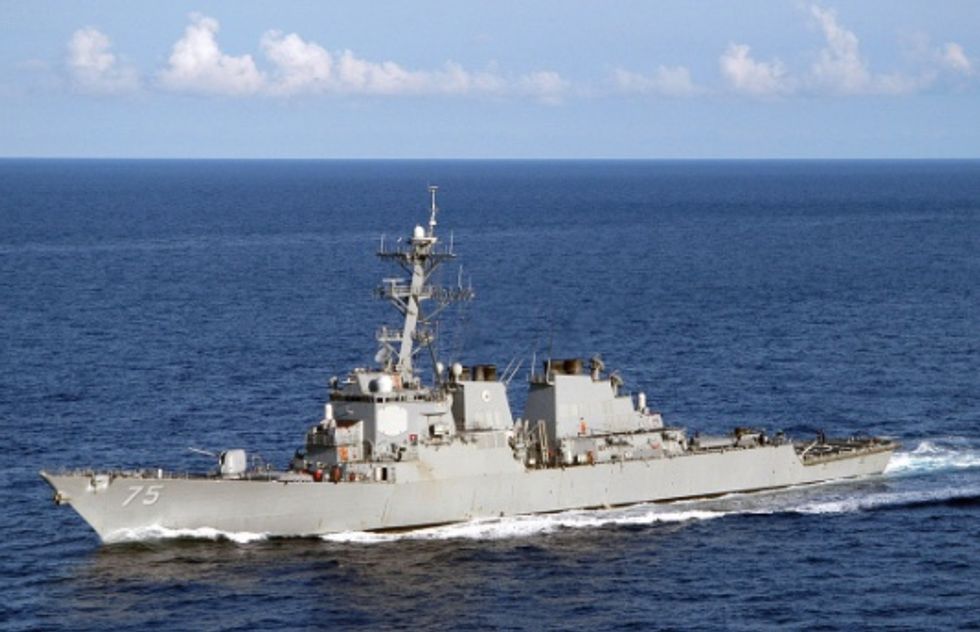
Oddly, it's all alone there in the Mediterranean. Other US ships appear to be days away. Perhaps it's "odd" in the same way as when the best ships in the seventh fleet were conveniently out of harm's way when Pearl Harbor was attacked, leaving only older less seaworthy ships to be sunk, and giving President Roosevelt the casus belli he needed to get America into WW2.

Will the USS Donald Cook be the neo-cons' sacrifice as they endeavor to get their war with Russia kicked into a higher gear?

The US, for its part, is apparently busy communicating with the Russians, communicating it will seek to avoid killing any Russians if at all possible should it strike Syria. This will limit the range of targets, but the risks are still very, very high:

A strike against Syria will likely come in the form of missiles, as was the case last year.

The United States would not want to risk putting manned aircraft over Syrian air defenses — a shoot-down would send the conflict spiraling in unforeseeable new directions.

The USS Donald Cook, an Arleigh Burke-class guided-missile destroyer, is within easy striking range of Syria, as is a French frigate with its own cruise missiles.

These two ships, possibly aided by a US submarine, are likely to play a role in a strike.

What are the risks?

The reaction from Assad backer Moscow is unpredictable and Russia has threatened retaliatory action against the United States if missiles are fired at Syria.

The Russian army on Wednesday accused the White Helmets civil defense organization of staging a chemical weapons attack in Douma, where observers say more than 40 people died in a gas attack.

NBC News reported Tuesday that Russia has learned how to use GPS jammers to limit the capabilities of US drones operating over Syria.

“The US has to be very careful not to accidentally strike Russian targets or kill Russian advisors," Ben Connable, a senior political scientist at the RAND Corporation, told AFP.

“That significantly limits the number of options available to the United States, because the Russians are embedded in many cases with the Syrians."

Connable warned that if the US accidentally or purposefully kills uniformed Russian soldiers, there would potentially be a dangerous escalation between the two nuclear powers.

(Source)

The plan here is for Trump get to appear tough, garnering the praise of the war party in the US (which is solidly bi-partisan) and the war press (the entire MSM), while not killing any Russians and, frankly, not doing too much actual damage to Syria.

This is pretty much from the same playbook as last year's false-flag gas attack in Syria, when we fired 59 Tomahawk missiles.

But this time, Russia has made it clear that any repeat of last year's missile attack will have consequences. It has moved its key naval assets out of port and into strike positions:

APRIL 12, 2018: RUSSIA STARTS EXERCISES OFF SYRIAN COAST, VOWS RESPONSE TO US STRIKES

The Russian Navy has launched live-fire exercises off the Syrian coast as the US is still preparing for a possible military action against the country's government.

The Russian exercises will be held from April 11 to April 26, the period when, according to some experts, the US strike will be most likely if the administration of US President Donald Trump decides to attack Syria.

On April 10, Russia's envoy to Lebanon Alexander Zasypkin once again confirming that Russian forces are ready to shoot down missiles and target the launchers in case of an escalation in the war-torn country.

Ali Akbar Velayati, the top adviser to Iran's supreme leader Ali Khamenei, vowed to support the Damascus government against any attack of the US and its allies.

So now we have Russian ships in the Mediterranean on live-fire exercises, bumping around a smallish sea with US naval assets, with everybody on pins and needles as NATO-Russia relations break down and tensions rise.

What could possibly go wrong?

Again, sane people ought to be asking why we are even in this position in the first place. Exactly what US interests are at risk in Syria? Whatever they may be, is defending them worth risking a hot confrontation with a nuclear power over? So far, I've seen zero compelling explanations on this front.

A Dangerous Advertising Campaign?

Looked at from a different angle, here's an interesting article from a Russian newspaper (translated by Google so please read past the choppy writing…) which posits that the attack will be proven a useful test of Russia's latest anti-missile systems.

If successful, Russia may well get to sell lots of them in the future. Great news comrades! We're getting the chance to showcase our products!

The S-400 and "Pantsiri" are preparing for a grandiose exam in Syria

"Russian air defense systems in Syria have an opportunity to show everything they are capable of," a source close to the Russian Defense Ministry noted in a comment to the newspaper VZGLYAD. Such a check is worth a lot, the interlocutor notes.

"For the military all over the world, this will be an extremely important lesson - the analysis of this blow and its reflection will long be handled by the headquarters of all the leading military powers of the world," the general believes. The subject of analysis will also be how the electronic warfare complexes (EW) will work when reflecting missile strikes.

The number of downed enemy missiles is not an end in itself, Lieutenant-General Alexander Gorkov, head of the air defense missile forces in 2000-2008, remarked in conversation with the newspaper VZGLYAD. He stressed: "The air defense forces are designed to completely conserve the object. Therefore, if only one of the 100 rockets is shot down, but the one that flew exactly to the target, and because of this the object survived, this is considered a success. "

But there are objective criteria for anti-aircraft gunners.

This indicator means the probability of a target being hit by one missile. The number of intercepted targets is divided by the total number of missiles fired. For example, less than 0.7 means low efficiency; 0.8 and above - good, 0.9 - excellent, explained earlier to the portal " Economy Today " Lieutenant General Aitech Bizhev, former deputy commander-in-chief of the Russian Air Force on the CIS Joint Air Defense System.

"If we are talking about cruise missiles going at extremely low altitudes, then the efficiency should be at least 0.85-0.90,

As an example, Bezhev cited the result of the Syrian air defense forces, which recently repulsed the attack of Israeli aircraft. F-15 planes fired eight missiles, the Syrians intercepted five of them. Thus, the coefficient was 0.6, that is 60% of the shot down missiles. This result is not very pleasing, Bezhev complained.

However, the expert of the Center for Analysis of Strategies and Technologies (ACT) Vasily Kashin believes that the destruction of 50-60% of US missiles would be a huge success for Russian weapons. In fact, he added, even the destruction of 30% can be considered a great success, if we bear in mind both Russian and Syrian air defense forces.

It should be taken into account that the Syrians used old complexes, notes Bizhev. And the newest S-400 air defense systems are located at Russian facilities - the Khmeimim base and in Tartus. According to the Lieutenant-General, the efficiency of the S-400 for unobtrusive speed targets is 0.9, that is "magnificent", 90%.

In turn, Kashin recalls: in addition to our ground-based air defense in Syria will be two Russian frigates with the complex "Shtil-1", which stand off the coast of Syria. "Each of them has a vertical launch for 24 anti-aircraft missiles," the expert reminded VZGLYAD.

Potential buyers of weapons following the outcome of this conflict will draw conclusions about which weapon systems are more effective - American cruise missiles or Russian air defense systems. For a correct assessment, it is important to consider how many missiles are fired at the covered targets. "If the enemy will use a huge number of missiles, for example, more than 200, then you do not know exactly how many missiles will be on the target. Miracles do not happen, "Kashin said. He adds that it is impossible to completely repulse such a blow.

"For example, there are 100 air targets, for each we spend two anti-missiles. With this amount you need to have a very high ammunition. Is there such a number of missiles in the ammunition of the grouping deployed in Syria? "Asks General Alexander Gorkov.

"The combat component of the S-300 division is 32 missiles (if there are eight launchers) or 48 missiles, if 12 units are available," the interlocutor points out. "If two rockets are used for each shooting, the ammunition will be enough for 16 or 24 launches, respectively." If the coefficient of 0.9 is shown in these shootings, this will be evaluated as a success, including potential buyers of Russian weapons.

Even if that was a little long and technical for you, just know I find it possibly comforting. If Russia is looking for a 'grandiose exam' of its war matériel, and the US is going to attack mainly to satisfy internal politics (and Russia knows this), then that may contain any military exchange to a relatively small skirmish (for now).

But if not, and Russia is truly backed into a corner, tired of the West's vilification and NATO's encroachment, it will show it claws. History has long shown that the Middle East is a powder keg where conflicts can easily escalate quickly. Where escalation might lead in this case is very worrisome indeed.

Time To Prepare For War

There remains, as yet, no evidence proving Assad's government was behind the alleged gas attack in Douma.

All that's been presented to the world are video clips showing what appear to be stricken people. However, we have long learned that such videos prove to be fraudulent. The same White Helmets who released these clips have been caught many times before using crisis actors and staging events that look just like the videos released -- shaking cameras that sweep and lurch in tights shots over closely spaced bodies, poor lighting, etc.

Moreover, the US and NATO blamed Assad and Russia within hours of these release of these videos, well before any actual evidence could have been collected and confirmed. As of course, they've similarly done time and again over the past years. Clearly, there's an eagerness on the West's side to find a reason to take harder action against Russia.

Will this one be it?

While the prospect of a kinetic (shooting) conflict between the West and Russia is obviously of greatest concern, the war could happen in one or several of many other forms (cyber, financial, trade, etc.) which I've written about extensively in the past.

We need to prepare ourselves for the prospect of war, even if this situation merely turns out to be an S-400 marketing blitz. Because at the current trajectory, even if this event turns out not to be the flashpoint that ignites a larger confrontation, the odds of one that does happening soon is just too damn high.

It's very clear that the US has embedded neocons that want a unipolar world where the US is top dog and gets to boss around China and Russia. That makes war “highly likely" in our future.

China and Russia quite rightly believe that they deserve to be treated on more equal footing and have their own national pride and internal political realities with which to contend, meaning they cannot appear to be pushed around by the US. Saving face is important.

In Part 2: What To Prepare For we assess the most likely paths the current standoff may take, the probability of each, and what the ramifications of each would be. Knowing tomorrow's likeliest outcomes will help you best prepare today.

An escalating conflict between the US and Russia, even if limited to a proxy war in Syria, will result in tremendous casualites -- of life, of geopolicital relations, and of markets. Protect yourself, those you love, and your wealth from becoming part of the collateral damage.

Click here to read Part 2 of this report (free executive summary, enrollment required for full access)

1 in 20 Canadians die by MAID—Is this 'compassion'?

Vaughn Ridley / Stringer | Getty Images

Medical assistance in dying isn’t health care. It’s the moment a Western democracy decided some lives aren’t worth saving, and it’s a warning sign we can’t ignore.

Canada loves to lecture America about compassion. Every time a shooting makes the headlines, Canadian commentators cannot wait to discuss how the United States has a “culture of death” because we refuse to regulate guns the way enlightened nations supposedly do.

But north of our border, a very different crisis is unfolding — one that is harder to moralize because it exposes a deeper cultural failure.

A society that no longer recognizes the value of life will not long defend freedom, dignity, or moral order.

The Canadian government is not only permitting death, but it’s also administering, expanding, and redefining it as “medical care.” Medical assistance in dying is no longer a rare, tragic exception. It has become one of the country’s leading causes of death, offered to people whose problems are treatable, whose conditions are survivable, and whose value should never have been in question.

In Canada, MAID is now responsible for nearly 5% of all deaths — 1 out of every 20 citizens. And this is happening in a country that claims the moral high ground over American gun violence. Canada now records more deaths per capita from doctors administering lethal drugs than America records from firearms. Their number is 37.9 deaths per 100,000 people. Ours is 13.7. Yet we are the country supposedly drowning in a “culture of death.”

No lecture from abroad can paper over this fact: Canada has built a system where eliminating suffering increasingly means eliminating the sufferer.

Choosing death over care

One example of what Canada now calls “compassion” is the case of Jolene Bond, a woman suffering from a painful but treatable thyroid condition that causes dangerously high calcium levels, bone deterioration, soft-tissue damage, nausea, and unrelenting pain. Her condition is severe, but it is not terminal. Surgery could help her. And in a functioning medical system, she would have it.

But Jolene lives under socialized medicine. The specialists she needs are either unavailable, overrun with patients, or blocked behind bureaucratic requirements she cannot meet. She cannot get a referral. She cannot get an appointment. She cannot reach the doctor in another province who is qualified to perform the operation. Every pathway to treatment is jammed by paperwork, shortages, and waitlists that stretch into the horizon and beyond.

Yet the Canadian government had something else ready for her — something immediate.

They offered her MAID.

Not help, not relief, not a doctor willing to drive across a provincial line and simply examine her. Instead, Canada offered Jolene a state-approved death. A lethal injection is easier to obtain than a medical referral. Killing her would be easier than treating her. And the system calls that compassion.

Bureaucracy replaces medicine

Jolene’s story is not an outlier. It is the logical outcome of a system that cannot keep its promises. When the machinery of socialized medicine breaks down, the state simply replaces care with a final, irreversible “solution.” A bureaucratic checkbox becomes the last decision of a person’s life.

Canada insists its process is rigorous, humane, and safeguarded. Yet the bureaucracy now reviewing Jolene’s case is not asking how she can receive treatment; it is asking whether she has enough signatures to qualify for a lethal injection. And the debate among Canadian officials is not how to preserve life, but whether she has met the paperwork threshold to end it.

This is the dark inversion that always emerges when the state claims the power to decide when life is no longer worth living. Bureaucracy replaces conscience. Eligibility criteria replace compassion. A panel of physicians replaces the family gathered at a bedside. And eventually, the “right” to die becomes an expectation — especially for those who are poor, elderly, or alone.

Joe Raedle / Staff | Getty Images

The logical end of a broken system

We ignore this lesson at our own peril. Canada’s health care system is collapsing under demographic pressure, uncontrolled migration, and the unavoidable math of government-run medicine.

When the system breaks, someone must bear the cost. MAID has become the release valve.

The ideology behind this system is already drifting south. In American medical journals and bioethics conferences, you will hear this same rhetoric. The argument is always dressed in compassion. But underneath, it reduces the value of human life to a calculation: Are you useful? Are you affordable? Are you too much of a burden?

The West was built on a conviction that every human life has inherent value. That truth gave us hospitals before it gave us universities. It gave us charity before it gave us science. It is written into the Declaration of Independence.

Canada’s MAID program reveals what happens when a country lets that foundation erode. Life becomes negotiable, and suffering becomes a justification for elimination.

A society that no longer recognizes the value of life will not long defend freedom, dignity, or moral order. If compassion becomes indistinguishable from convenience, and if medicine becomes indistinguishable from euthanasia, the West will have abandoned the very principles that built it. That is the lesson from our northern neighbor — a warning, not a blueprint.

This article originally appeared on TheBlaze.com.

A Sharia enclave is quietly taking root in America. It's time to wake up.

NOVA SAFO / Staff | Getty Images

Sharia-based projects like the Meadow in Texas show how political Islam grows quietly, counting on Americans to stay silent while an incompatible legal system takes root.

Apolitical system completely incompatible with the Constitution is gaining ground in the United States, and we are pretending it is not happening.

Sharia — the legal and political framework of Islam — is being woven into developments, institutions, and neighborhoods, including a massive project in Texas. And the consequences will be enormous if we continue to look the other way.

This is the contradiction at the heart of political Islam: It claims universal authority while insisting its harshest rules will never be enforced here. That promise does not stand up to scrutiny. It never has.

Before we can have an honest debate, we’d better understand what Sharia represents. Sharia is not simply a set of religious rules about prayer or diet. It is a comprehensive legal and political structure that governs marriage, finance, criminal penalties, and civic life. It is a parallel system that claims supremacy wherever it takes hold.

This is where the distinction matters. Many Muslims in America want nothing to do with Sharia governance. They came here precisely because they lived under it. But political Islam — the movement that seeks to implement Sharia as law — is not the same as personal religious belief.

It is a political ideology with global ambitions, much like communism. Secretary of State Marco Rubio recently warned that Islamist movements do not seek peaceful coexistence with the West. They seek dominance. History backs him up.

How Sharia arrives

Political Islam does not begin with dramatic declarations. It starts quietly, through enclaves that operate by their own rules. That is why the development once called EPIC City — now rebranded as the Meadow — is so concerning. Early plans framed it as a Muslim-only community built around a mega-mosque and governed by Sharia-compliant financing. After state investigations were conducted, the branding changed, but the underlying intent remained the same.

Developers have openly described practices designed to keep non-Muslims out, using fees and ownership structures to create de facto religious exclusivity. This is not assimilation. It is the construction of a parallel society within a constitutional republic.

The warning from those who have lived under it

Years ago, local imams in Texas told me, without hesitation, that certain Sharia punishments “just work.” They spoke about cutting off hands for theft, stoning adulterers, and maintaining separate standards of testimony for men and women. They insisted it was logical and effective while insisting they would never attempt to implement it in Texas.

But when pressed, they could not explain why a system they consider divinely mandated would suddenly stop applying once someone crossed a border.

This is the contradiction at the heart of political Islam: It claims universal authority while insisting its harshest rules will never be enforced here. That promise does not stand up to scrutiny. It never has.

AASHISH KIPHAYET / Contributor | Getty Images

America is vulnerable

Europe is already showing us where this road leads. No-go zones, parallel courts, political intimidation, and clerics preaching supremacy have taken root across major cities.

America’s strength has always come from its melting pot, but assimilation requires boundaries. It requires insisting that the Constitution, not religious law, is the supreme authority on this soil.

Yet we are becoming complacent, even fearful, about saying so. We mistake silence for tolerance. We mistake avoidance for fairness. Meanwhile, political Islam views this hesitation as weakness.

Religious freedom is one of America’s greatest gifts. Muslims may worship freely here, as they should. But political Islam must not be permitted to plant a flag on American soil. The Constitution cannot coexist with a system that denies equal rights, restricts speech, subordinates women, and places clerical authority above civil law.

Wake up before it is too late

Projects like the Meadow are not isolated. They are test runs, footholds, proofs of concept. Political Islam operates with patience. It advances through demographic growth, legal ambiguity, and cultural hesitation — and it counts on Americans being too polite, too distracted, or too afraid to confront it.

We cannot afford that luxury. If we fail to defend the principles that make this country free, we will one day find ourselves asking how a parallel system gained power right in front of us. The answer will be simple: We looked away.

The time to draw boundaries and to speak honestly is now. The time to defend the Constitution as the supreme law of the land is now. Act while there is still time.

This article originally appeared on TheBlaze.com.

Why do Americans feel so empty?

Mario Tama / Staff | Getty Images

Anxiety, anger, and chronic dissatisfaction signal a country searching for meaning. Without truth and purpose, politics becomes a dangerous substitute for identity.

We have built a world overflowing with noise, convenience, and endless choice, yet something essential has slipped out of reach. You can sense it in the restless mood of the country, the anxiety among young people who cannot explain why they feel empty, in the angry confusion that dominates our politics.

We have more wealth than any nation in history, but the heart of the culture feels strangely malnourished. Before we can debate debt or elections, we must confront the reality that we created a world of things, but not a world of purpose.

You cannot survive a crisis you refuse to name, and you cannot rebuild a world whose foundations you no longer understand.

What we are living through is not just economic or political dysfunction. It is the vacuum that appears when a civilization mistakes abundance for meaning.

Modern life is stuffed with everything except what the human soul actually needs. We built systems to make life faster, easier, and more efficient — and then wondered why those systems cannot teach our children who they are, why they matter, or what is worth living for.

We tell the next generation to chase success, influence, and wealth, turning childhood into branding. We ask kids what they want to do, not who they want to be. We build a world wired for dopamine rather than dignity, and then we wonder why so many people feel unmoored.

When everything is curated, optimized, and delivered at the push of a button, the question “what is my life for?” gets lost in the static.

The crisis beneath the headlines

It is not just the young who feel this crisis. Every part of our society is straining under the weight of meaninglessness.

Look at the debt cycle — the mathematical fate no civilization has ever escaped once it crosses a threshold that we seem to have already blown by. While ordinary families feel the pressure, our leaders respond with distraction, with denial, or by rewriting the very history that could have warned us.

You cannot survive a crisis you refuse to name, and you cannot rebuild a world whose foundations you no longer understand.

We have entered a cultural moment where the noise is so loud that it drowns out the simplest truths. We are living in a country that no longer knows how to hear itself think.

So people go searching. Some drift toward the false promise of socialism, some toward the empty thrill of rebellion. Some simply check out. When a culture forgets what gives life meaning, it becomes vulnerable to every ideology that offers a quick answer.

The quiet return of meaning

And yet, quietly, something else is happening. Beneath the frustration and cynicism, many Americans are recognizing that meaning does not come from what we own, but from what we honor. It does not rise from success, but from virtue. It does not emerge from noise, but from the small, sacred things that modern life has pushed to the margins — the home, the table, the duty you fulfill, the person you help when no one is watching.

The danger is assuming that this rediscovery happens on its own. It does not.

Reorientation requires intention. It requires rebuilding the habits and virtues that once held us together. It requires telling the truth about our history instead of rewriting it to fit today’s narratives. And it requires acknowledging what has been erased: that meaning is inseparable from God’s presence in a nation’s life.

Harold M. Lambert / Contributor | Getty Images

Where renewal begins

We have built a world without stillness, and then we wondered why no one can hear the questions that matter. Those questions remain, whether we acknowledge them or not. They do not disappear just because we drown them in entertainment or noise. They wait for us, and the longer we ignore them, the more disoriented we become.

Meaning is still available. It is found in rebuilding the smallest, most human spaces — the places that cannot be digitized, globalized, or automated. The home. The family. The community.

These are the daily virtues that do not trend on social media, but that hold a civilization upright. If we want to repair this country, we begin there, exactly where every durable civilization has always begun: one virtue at a time, one tradition at a time, one generation at a time.

This article originally appeared on TheBlaze.com.

The Bubba Effect erupts as America’s power brokers go rogue

Gary Hershorn / Contributor | Getty Images

When institutions betray the public’s trust, the country splits, and the spiral is hard to stop.

Something drastic is happening in American life. Headlines that should leave us stunned barely register anymore. Stories that once would have united the country instead dissolve into silence or shrugs.

It is not apathy exactly. It is something deeper — a growing belief that the people in charge either cannot or will not fix what is broken.

When people feel ignored or betrayed, they will align with anyone who appears willing to fight on their behalf.

I call this response the Bubba effect. It describes what happens when institutions lose so much public trust that “Bubba,” the average American minding his own business, finally throws his hands up and says, “Fine. I will handle it myself.” Not because he wants to, but because the system that was supposed to protect him now feels indifferent, corrupt, or openly hostile.

The Bubba effect is not a political movement. It is a survival instinct.

What triggers the Bubba effect

We are watching the triggers unfold in real time. When members of Congress publicly encourage active duty troops to disregard orders from the commander in chief, that is not a political squabble. When a federal judge quietly rewrites the rules so one branch of government can secretly surveil another, that is not normal. That is how republics fall. Yet these stories glided across the news cycle without urgency, without consequence, without explanation.

When the American people see the leadership class shrug, they conclude — correctly — that no one is steering the ship.

This is how the Bubba effect spreads. It is not just individuals resisting authority. It is sheriffs refusing to enforce new policies, school boards ignoring state mandates, entire communities saying, “We do not believe you anymore.” It becomes institutional, cultural, national.

A country cracking from the inside

This effect can be seen in Dearborn, Michigan. In the rise of fringe voices like Nick Fuentes. In the Epstein scandal, where powerful people could not seem to locate a single accountable adult. These stories are different in content but identical in message: The system protects itself, not you.

When people feel ignored or betrayed, they will align with anyone who appears willing to fight on their behalf. That does not mean they suddenly agree with everything that person says. It means they feel abandoned by the institutions that were supposed to be trustworthy.

The Bubba effect is what fills that vacuum.

The dangers of a faithless system

A republic cannot survive without credibility. Congress cannot oversee intelligence agencies if it refuses to discipline its own members. The military cannot remain apolitical if its chain of command becomes optional. The judiciary cannot defend the Constitution while inventing loopholes that erase the separation of powers.

History shows that once a nation militarizes politics, normalizes constitutional shortcuts, or allows government agencies to operate without scrutiny, it does not return to equilibrium peacefully. Something will give.

The question is what — and when.

The responsibility now belongs to us

In a healthy country, this is where the media steps in. This is where universities, pastors, journalists, and cultural leaders pause the outrage machine and explain what is at stake. But today, too many see themselves not as guardians of the republic, but of ideology. Their first loyalty is to narrative, not truth.

The founders never trusted the press more than the public. They trusted citizens who understood their rights, lived their responsibilities, and demanded accountability. That is the antidote to the Bubba effect — not rage, but citizenship.

How to respond without breaking ourselves

Do not riot. Do not withdraw. Do not cheer on destruction just because you dislike the target. That is how nations lose themselves. Instead, demand transparency. Call your representatives. Insist on consequences. Refuse to normalize constitutional violations simply because “everyone does it.” If you expect nothing, you will get nothing.

Do not hand your voice to the loudest warrior simply because he is swinging a bat at the establishment. You do not beat corruption by joining a different version of it. You beat it by modeling the country you want to preserve: principled, accountable, rooted in truth.

Adam Gray / Stringer | Getty Images

Every republic reaches a moment when historians will later say, “That was the warning.” We are living in ours. But warnings are gifts if they are recognized. Institutions bend. People fail. The Constitution can recover — if enough Americans still know and cherish it.

It does not take a majority. Twenty percent of the country — awake, educated, and courageous — can reset the system. It has happened before. It can happen again.

Wake up. Stand up. Demand integrity — from leaders, from institutions, and from yourself. Because the Bubba effect will not end until Americans reclaim the duty that has always belonged to them: preserving the republic for the next generation.

This article originally appeared on TheBlaze.com.