
As we move along this endless primary season, we implement our first major adjustments to our power rankings model. Because of all the changes on the model itself, we'll keep the write ups short this week so that we can get an update posted before we hit the second round of debates.
There are now 40 separate measures of candidate performance which are summarized by the 0-100 score that helps us makes sense out of this chaos.We also have a new style of graphs, where the section highlighted in blue will show the progress (or lack thereof) made by each candidate over the life of their campaign.
In this update, we have our first campaign obituary, a couple of brand new candidates (when will it ever stop) and plenty of movement up top.
Let's get to it.
In case you're new here, read our explainer about how all of this works:
The 2020 Democratic primary power rankings are an attempt to make sense out of the chaos of the largest field of candidates in global history. Each candidate gets a unique score in at least thirty categories, measuring data like polling, prediction markets, fundraising, fundamentals, media coverage, and more. The result is a candidate score between 0-100. These numbers will change from week to week as the race changes. The power rankings are less a prediction on who will win the nomination, and more a snapshot of the state of the race at any given time. However, early on, the model gives more weight to fundamentals and potentials, and later will begin to prioritize polling and realities on the ground. If you're like me, when you read power rankings about sports, you've already skipped ahead to the list. So, here we go.
See previous editions here.
Campaign Obituary #1
The Eric Swalwell Campaign
California State Congressman
April 8, 2019 - July 8, 2019
Lifetime high: 20.2
Lifetime low: 19.5
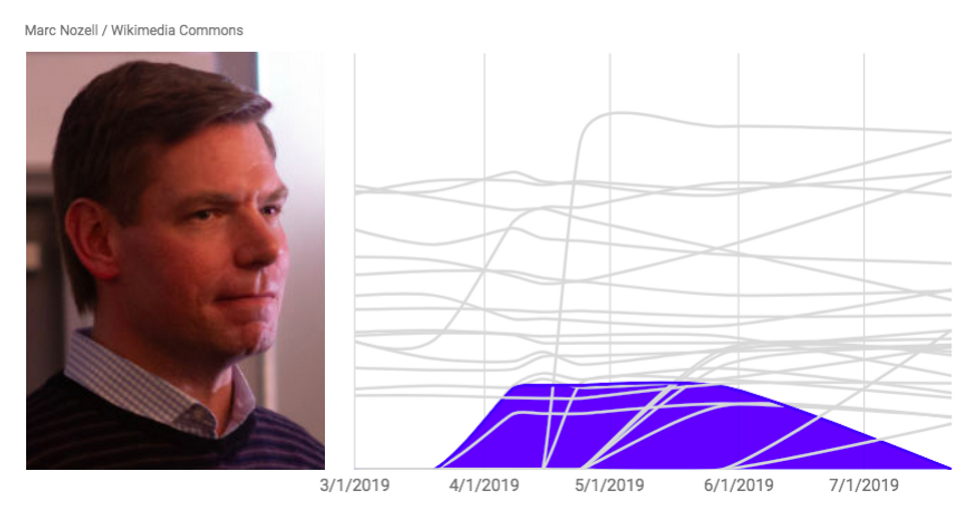
I ended my initial profile on Eric Swalwell with this:
"There's a certain brand of presidential candidate that isn't really running for president. That's Eric Swalwell."
It's now more true than ever that Swalwell isn't running for president, because he has officially dropped out of the race.
To any sane observer, Swalwell never had a chance to win the nomination. This was always about raising his profile with little downside to deter him from taking money and building a list of future donors.
In one of many depressing moments in his FiveThirtyEight exit interview, he noted that one of his supporters told him he definitely thought he'd eventually be president, but it wasn't going to happen this time. (This supporter was not identified, but we can logically assume they also have the last name Swalwell.)
Swalwell did outline a series of reasons he thought his ridiculous campaign might have a chance.
- He was born in Iowa. After all, people from Iowa will surely vote for someone born in Iowa, even if they escaped as soon as possible.
- He had what he believed was a signature issue: pretending there was no such amendment as the second amendment.)
- He's not old.
It was on point number three where Swalwell made his last stand. In an uncomfortably obvious attempt to capture a viral moment that would launch his fundraising and polling status, Swalwell went after Joe Biden directly.
"I was 6 years old when a presidential candidate came to the California Democratic Convention and said it's time to pass the torch to a new generation of Americans. That candidate was then-Senator Joe Biden." This pre-meditated and under-medicated attack, along with Swalwell's entire campaign future, was disassembled by a facial gesture.
Biden's response wasn't an intimidation, anger, or a laugh. It was a giant smile that somehow successfully communicated a grandfathery dismissal of "isn't that just adorable."
Of course, headlines like this didn't help either:
Eric Swalwell is going to keep comparing the Democratic field to 'The Avengers' until someone claps
The campaign of Eric Swalwell was pronounced dead at the age of 91 days.
Other headlines:
Eric Swalwell ends White House bid, citing low polling, fundraising
Republicans troll Swalwell for ending presidential campaign
Eric Swalwell Latest 'Cringe' Video Brags About Omar Holding his 'White' Baby
Eric Swalwell's message to actor Danny Glover is 'the cringiest thing I've ever seen in a hearing'
Eric Swalwell's 'I Will Be Bold Without The Bull' Bombs
25.Joe Sestak 11.0 (Debut) Former Pennsylvania State Congressman
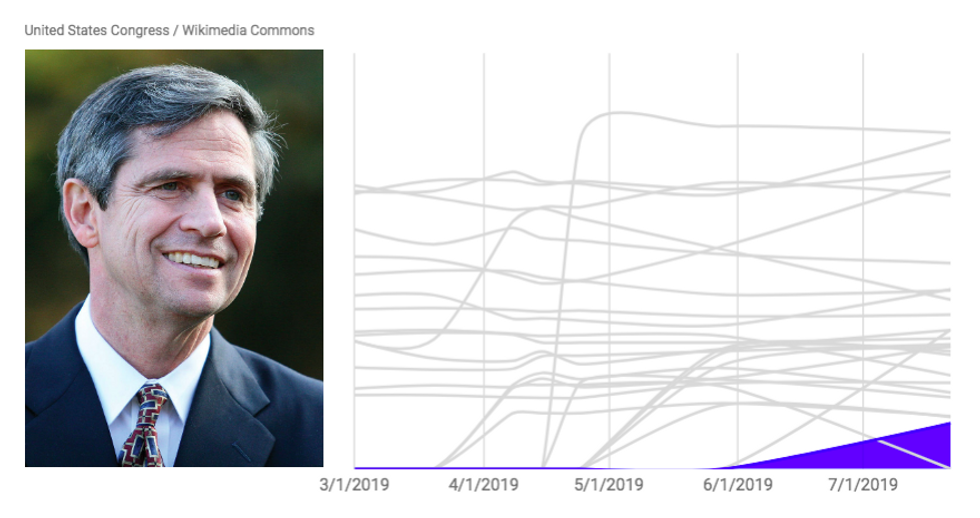
Joe Sestak is a former three-star admiral who served in Congress for a couple of years in the late 2000s. Besides his military service, his most notable achievement is figuring out a way to get Pat Toomey elected in a purple state.
With Arlen Specter finally formalizing his flip from Republican to Democrat in 2009, he was expected to cruise to reelection. However, Sestak went after him in the primary, and was able to knock him off in the by eight points. Sestak then advanced to face Republican Pat Toomey in the general election. He lost by two points during the Tea Party wave election of 2010.
Needless to say, losing to the former president of the fiscally conservative Club For Growth isn't exactly an accomplishment that is going to help Sestak in the Democratic presidential primary.
Unfortunately, with the current state of the party— his distinguished service in the Navy probably isn't helpful either.
Other headlines:
Joe Sestak on the issues, in under 500 words
Joe Sestak, latest 2020 candidate, says it's not too late for him to gain traction
Sestak aims to 'heal the soul of America' with presidential bid
Joe Sestak Would Move the US Embassy 'Back Out of Jerusalem'
24.Mike Gravel: 12.5 (Previous: 24th / 15.3) Former US Senator from Alaska
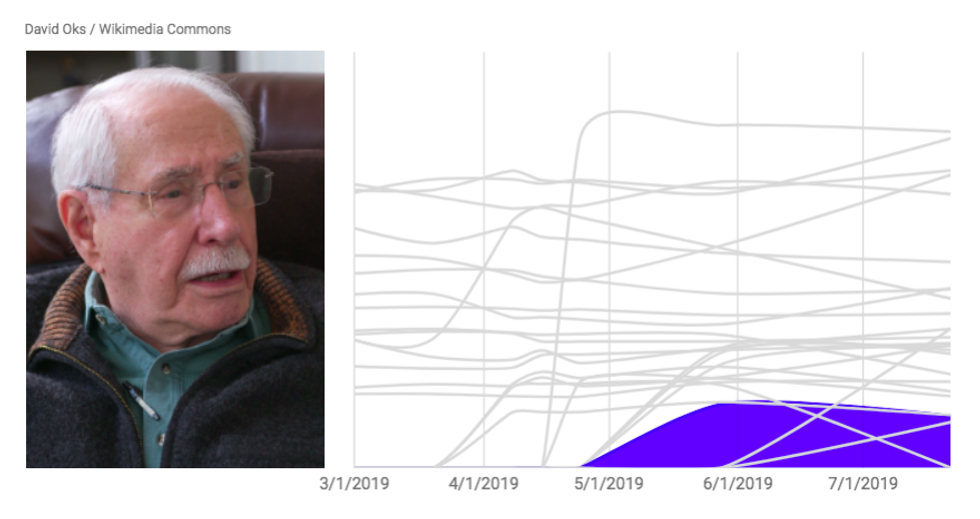
Gravel was able to get celebrities and other candidates to send out pleas to raise funds in effort to get above 65,000 donations and qualify for the second debate.
We may never know if it was grift or incompetence, but Gravel probably should have known that crossing this line made no difference. He'll still be yelling at the TV when the debate starts.
Other headlines:
Gravel meets donor threshold to qualify for Democratic primary debate
Gravel spends a bit of cash to run an ad against Joe Biden in Iowa
Mike Gravel: Why the American People Need Their Own Legislature
23.Wayne Messam: 12.7 (Previous: 23rd / 15.8) Mayor of Miramar, FL
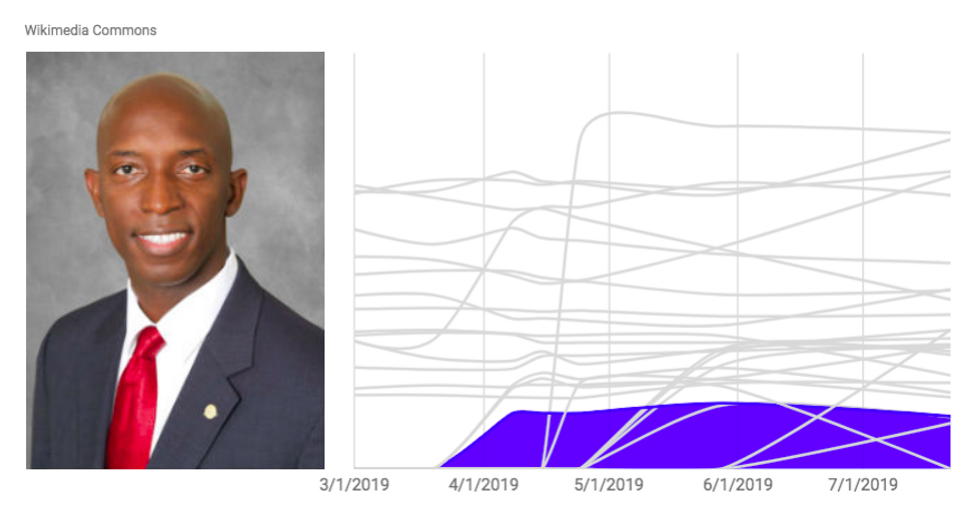
Messam has made no impact in this race so far, and has fundraising numbers that don't even get into the six digits, let alone seven. He's not really running a campaign at this point, so there's no real downside in staying in for now.
Other headlines:
Wayne Messam: Money Kept Me Out of the First Democratic Debate. Will It Keep Me Out of the Second?
22.Seth Moulton 17.2 (Previous 20th / 21.5) US Rep. from Massachusetts
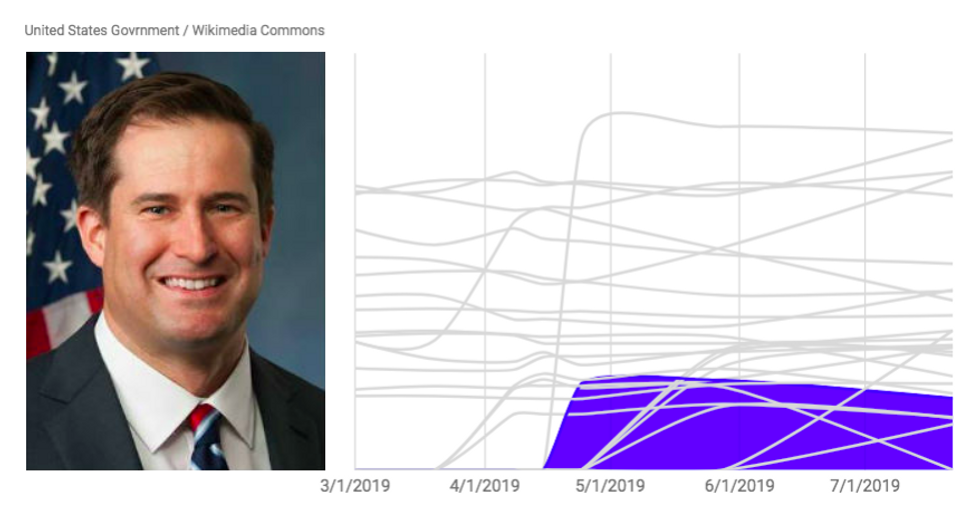
Seth Moulton is the invisible man on the campaign trail. Most people don't even know who he is when they're talking to him. His appeal to the Democratic party is heavily flavored with his military service and appeal to patriotism.
Good luck with that Seth.
Other headlines:
Moulton: Buttigieg Was a Nerd at Harvard
Moulton: Democrats shouldn't go on 'moral crusade' against Trump
Moulton talks reclaiming patriotism from Trump, Republicans
Moulton: 'Trump is going to be harder to beat than many Democrats like to believe'
21.Tim Ryan 18.4 (Previous: 18th / 24.3) US Rep. from Ohio
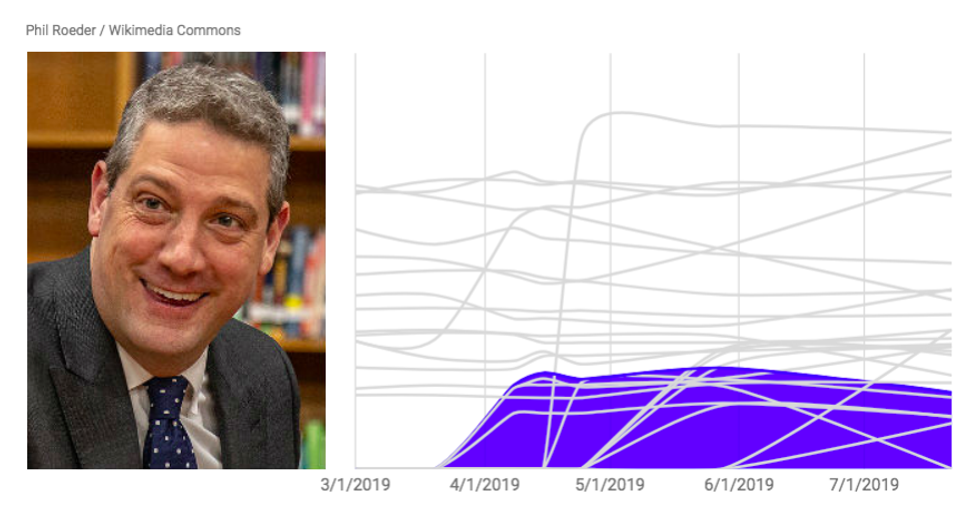
Tim Ryan's first debate performance was so bad he lost about a quarter of his score with this update. He's not without a plan to get that support back though. He wants to bring hot yoga to the people.
Other headlines:
20.Marianne Williamson 20.7 (Previous: 21st / 20.6) Author, Lecturer, Activist
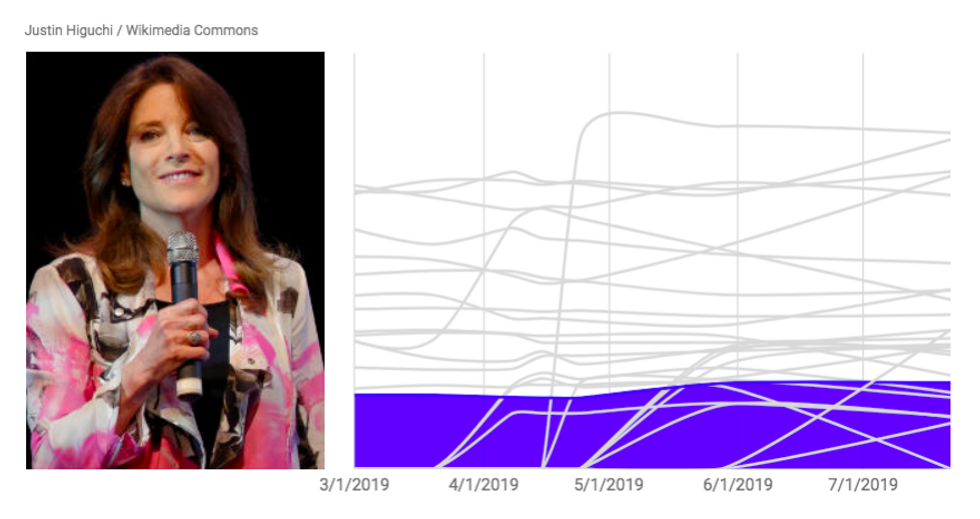
Williamson is not going to be the nominee for the Democrats, but if you throw a debate watch party, she might supply the most entertainment. So much so, Republicans have started to donate to her campaign to keep her in future debates.
Other headlines:
"I call her a modern-day prophet": Marianne Williamson's followers want you to give her a chance
Williamson Uses Anime to Explain 2020 Candidate's Holistic Politics
What Marianne Williamson and Donald Trump have in common
Marianne Williamson's Iowa director joins John Delaney's 2020 campaign
19.John Hickenlooper 22.5 (Previous: 11th / 32.0) Former Gov. of Colorado
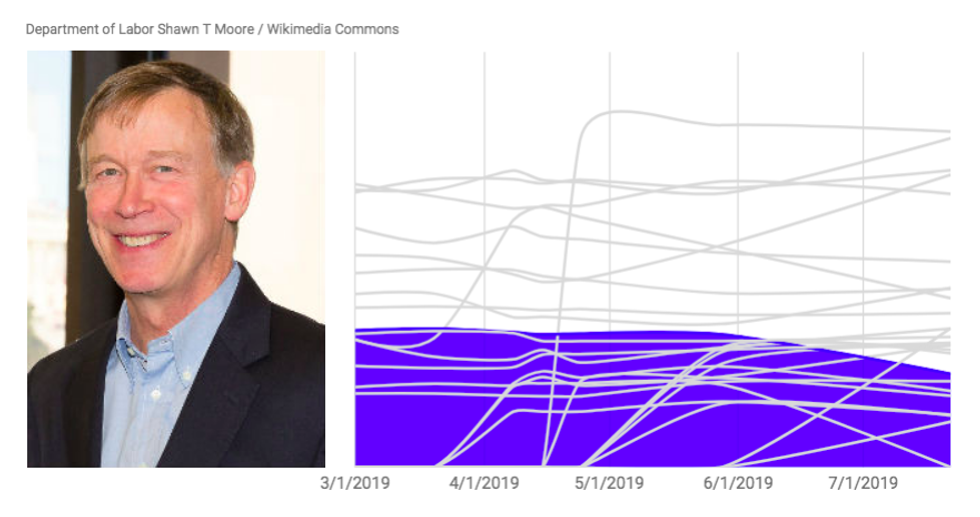
Hickenlooper has been shedding campaign advisors at a relatively furious pace as he admits "there's just a bunch of skills that don't come naturally to me" when it comes to campaigning.
Probably best to pick another line of work.
Other headlines:
Hickenlooper defends campaign fundraising to The Onion: 'The race is wide open'
WP: 'You are who?' The lonely presidential campaign of John Hickenlooper
Gary Hart Warns John Hickenlooper Against Campaigning On Bipartisanship Message
Hickenlooper refuses to condemn protesters who hoisted Mexican flag at ICE facility
18.Michael Bennet 27.4 (Previous: 14th / 28.8) US Senator from Colorado
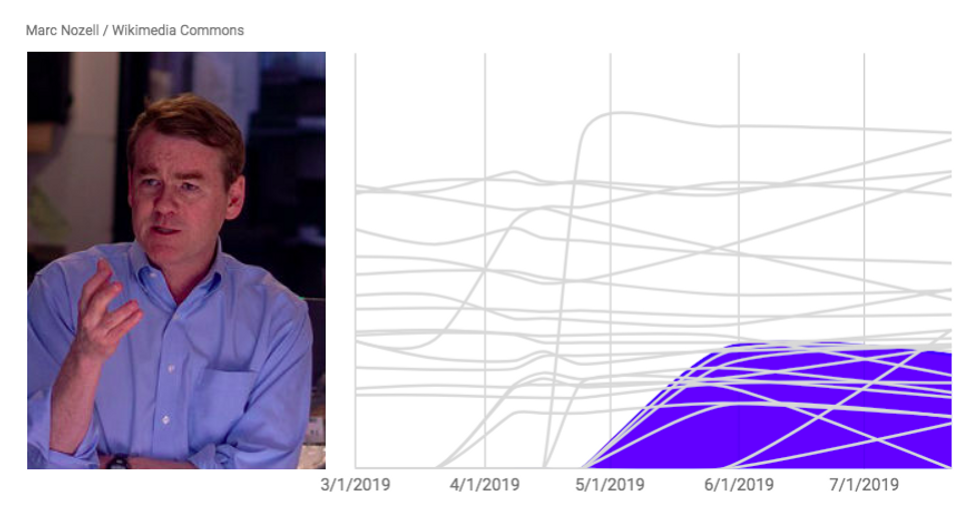
Michael Bennet is a bit of a boring no name, but give him credit for actually trying to differentiate himself from the field. He's one of the only candidates willing to criticize his socialist opponents from the center, calling out the open borders crowd and student debt. Obviously this has no chance of success in the democratic party, but at least he's trying.
Other headlines:
George Will touts Bennet to beat Trump in 2020
Bennet: America doesn't know what the Democratic Party stands for
17.Steve Bullock 28.3 (Previous: 16th / 27.7) Gov. of Montana
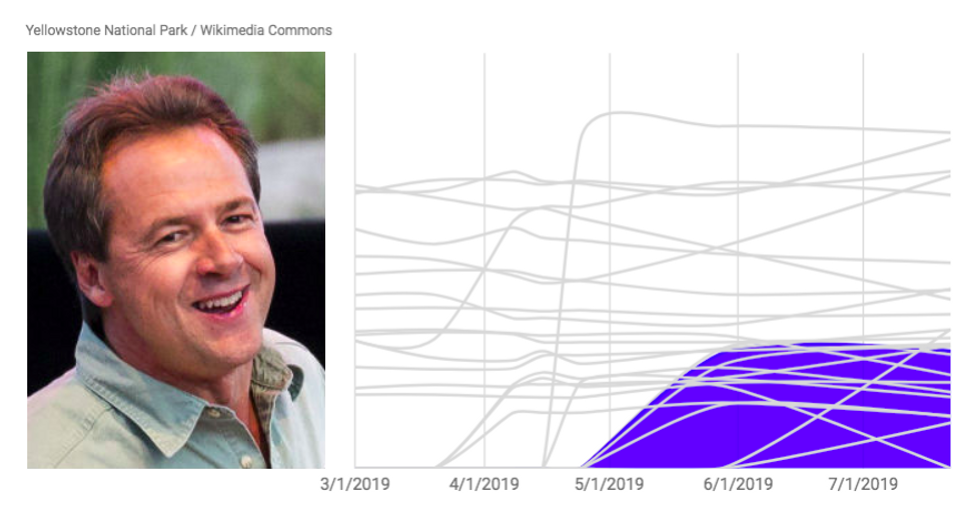
Bullock's biggest moment of his campaign, and quite possibly his only important moment , will come in this round of debates. He missed the first round, but squeaks in for round two after Eric Swalwell decided to take his zero percent and go home.
Bullock has a theoretical argument that doesn't look half bad on paper, but it seems impossible for another "moderate*" to make noise with Biden still hanging around.
(*-None of these moderates are actually moderate.)
Other headlines:
For Democratic presidential hopeful Steve Bullock, it's all about the 'dark money'
Steve Bullock hates 'dark money.' But a lobbyist for 'dark money' donors is helping his campaign.
Steve Bullock looking to introduce himself as someone who won in Trump country
Bullock said he's not one to eliminate all student-loan debt
Steve Bullock raises $2 million for 2020 bid in second quarter, campaign says
16.Bill de Blasio 29.3 (Previous: 17th / 24.9) Mayor of New York City, NY
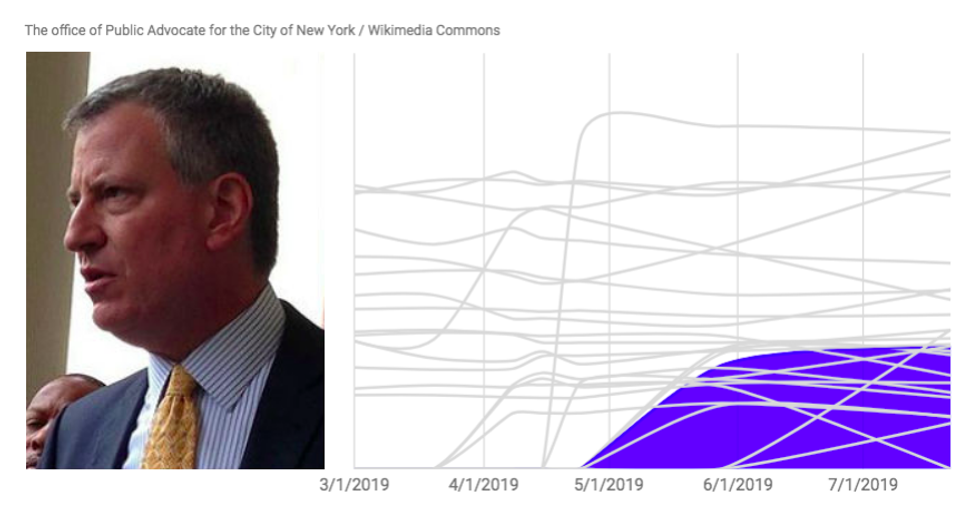
De Blasio is still the least popular Democrat in the field, but his complete lack of shame allows him to shine in a debate format.
In round two, expect Bill to attack Biden head on and look for the viral moment that could rocket him to a solid one or two percent in the polls.
Other headlines:
De Blasio blasts Biden over Obama administration's deportation record
Gov. Cuomo swipes at NYC Mayor Bill de Blasio for being absent when power outage hits
De Blasio's 2020 campaign is spending 'pennies' on digital ads
De Blasio shouts that he 'hates' charter schools at campaign event
De Blasio: Require equal pay for national sports teams
Bill De Blasio Is A Big Headed Hypocrite On The Gender Pay Gap
'This is Swalwell cringe levels': Bill de Blasio debate prep Tweet
15.John Delaney 29.5 (Previous 19th / 20.3) Former US Rep. from Maryland
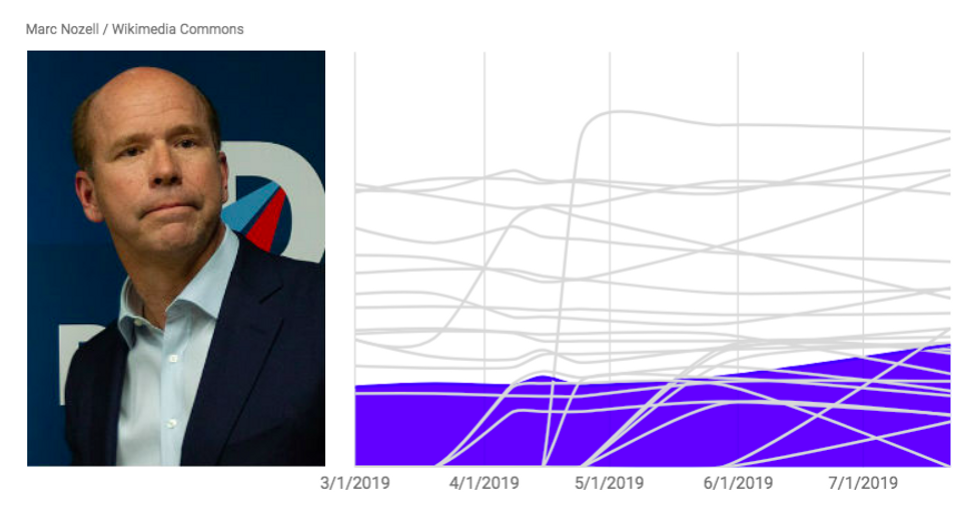
The power ranking model likes Delaney more than voters seem to like him. He continues to pour his own money into the race and at some point you have to believe someone in his life stops him from setting his cash on fire.
He did steal a key advisor from Marianne Williamson's campaign, which doesn't seem like a path to success.
Other headlines:
Delaney: "Non-Citizens Are Not Covered By My 'Better Care' Plan, But…"
Delaney says he opposes decriminalizing border crossings
Undaunted by low polling, John Delaney keeps his show on the road
Delaney presidential campaign theme: fix what's broken, keep what works
14.Andrew Yang 30.0 (Previous: 15th / 28.3) Attorney and Entrepreneur
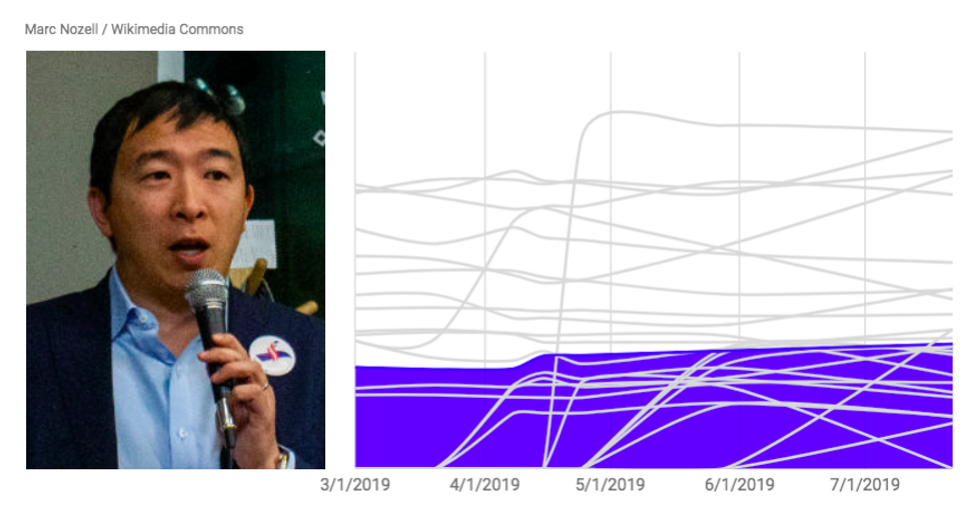
Before the campaign started, if you would have said Yang would be in the middle of the pack at this point, he probably would be happy with that result. His embrace of quirky issues like banning robocalls, giving everyone free cash, and spending $6 billion to fix the nations malls is enough to keep him in the news.
His fundraising was decent, and he remains an interesting and thoughtful candidate. But, Yang has a better chance of dropping out and running on a third party ticket than winning in this Democratic Party.
You do have to wonder how long it will be before the word "Math" moves from his campaign slogan to the reason he needs to drop out.
Other headlines:
Andrew Yang Is Targeting The 'Politically Disengaged' To 'Win The Whole Election'
You can't turn truck drivers into coders, Andrew Yang says of job retraining
Yang's plan to give $1000 a month to everyone is popular with young, poor Democrats
13.Jay Inslee 31.4 (Previous: 12th / 30.4) Gov. of Washington state
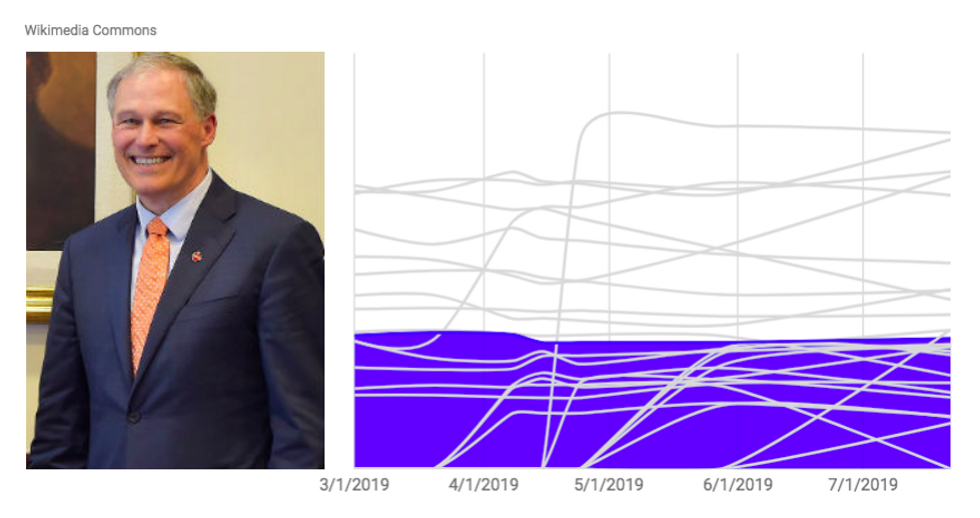
Expect Inslee to capture the king-czar-chancellor role of the new climate police or whatever draconian nightmare the actual Democratic nominee creates if they win.
In the meantime, he should try to avoid cringe inducing nonsense like this.
Other headlines:
Presidential hopeful Jay Inslee says Trump's immigration policies will 'end his presidency'
Crowd roars for Elizabeth Warren, Jay Inslee follows to tepid applause
Inslee on listening to Carole King, wanting an anchor tattoo
12.Tulsi Gabbard 33.4 (Previous: 13th / 28.8) US Rep. for Hawaii
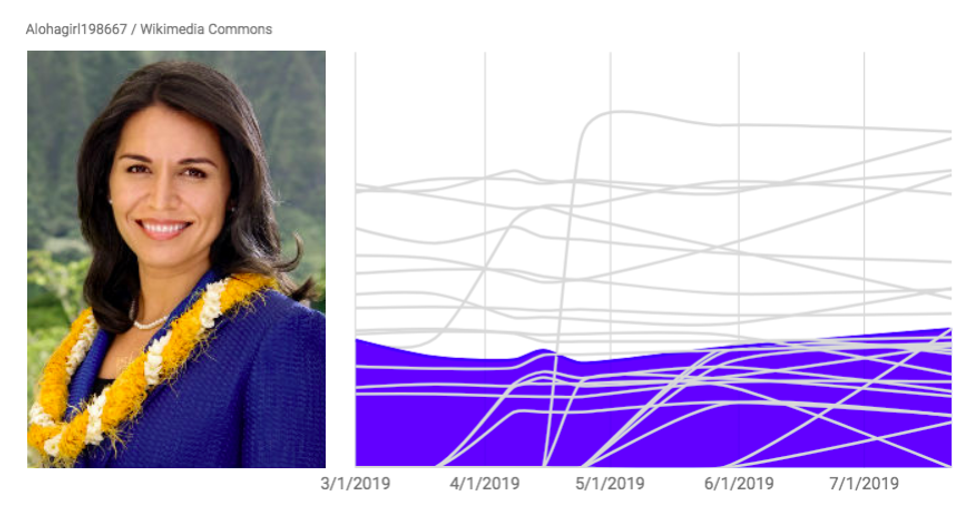
Tulsi Gabbard really wants to be Joe Biden's vice president. Or, at least, she wants to hold an important role in his cabinet, like Secretary of Defense.
Gabbard has been running interference for Biden, aggressively going after Kamala Harris for her very successful but substance free bussing attack, while hammering Harris as not qualified to be President. These have been among the harshest criticisms levied by any candidate in the race so far, and there is definitely a purpose to all of it. Her presence in the same debate as Biden and Harris should be something Harris prepares herself for. Expect incoming fire.
Along with Yang, Gabbard remains among the most interesting Democratic candidates to Republicans and Libertarians, which is not helpful to her chances of actually winning the Democratic party nod.
Other headlines:
Gabbard says Harris used "political ploy" to "smear" Biden on raced
Which U.S. Wars Were Justifiable? Tulsi Gabbard Names Only World War II
Tulsi Gabbard Says It's A 'Good Thing' Trump Met With Kim Jong Un
Gabbard Sympathizes With Amash, Says the Two-Party System Sucks
Tulsi Gabbard Files Bill To Study Hemp's Uses For Just About Everything
Gabbard: '14-year-old girl hacked into a replica of Florida's election system'
11.Tom Steyer 33.5 (Debut) Billionaire hedge fund manager
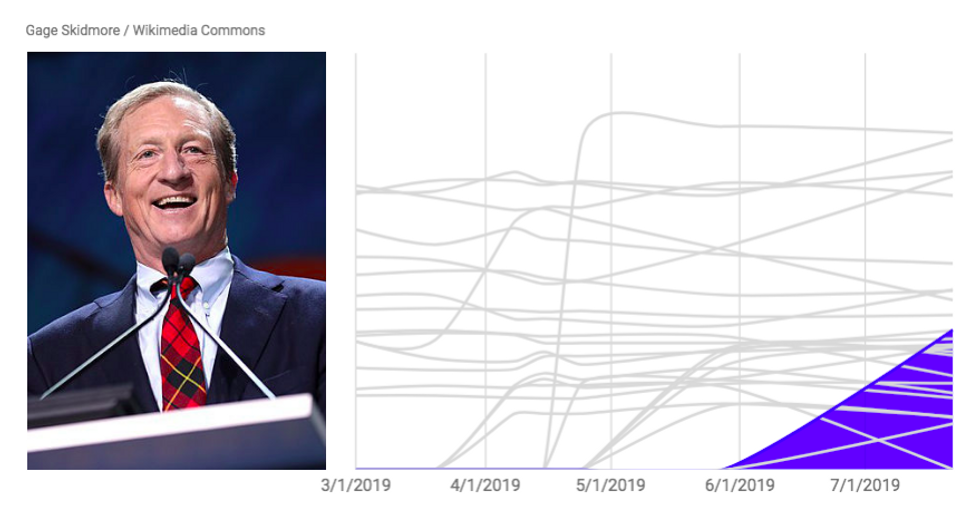
Tom Steyer is a Democratic billionaire that has spent millions plastering his face all over MSNBC for the past two years begging people to consider impeaching Donald Trump.
The campaign power ranking model loves Steyer's potential because of his unlimited money and theoretical ability to put together a serious campaign team.
All of this is theory at this point though, as the millions spent so far has lead to a giant pile of zilch. If he's serious enough, he should be able to buy his way into the low single digits, and squeak his way into a debate or two.
Steyer's billionaire status isn't an obvious fit as the party of inequality attempts to take down Donald Trump. But, he does have legitimate movement credibility, tons of cash to buy support, and a long developed immunity to embarrassment—so the sky is the limit.
Other headlines:
Tom Steyer on the issues, in under 500 words
Tom Steyer announces 2020 bid, reversing course
Why We're Not Treating Tom Steyer As A 'Major' Candidate (Yet)
10.Kirsten Gillibrand 37.1 (Previous: 9th / 36.7) US Senator from New York
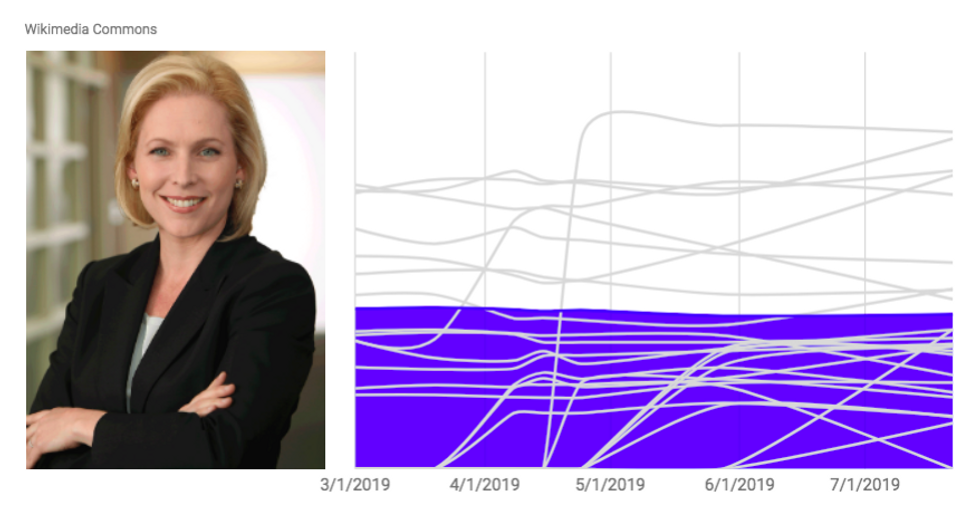
There is probably no candidate that enters the second round of debates more clearly in do-or-die mode than Gillibrand. With headlines like "The Ignoring of Kirsten Gillibrand" lighting up her feed, she needs something big to happen, and fast. Her performance in the first debate wasn't actually horrible, but still went unnoticed.
She has zero percent in lots of polls, and that includes all of the benefits she says she's received from white privilege. Imagine if she didn't have that going for her.
Other headlines:
Gillibrand: I'd Tell Concerned Coal Miner the Green New Deal Is 'Just Some Bipartisan Ideas'
Struggling in White House bid, Democrat Gillibrand seeks bump in Trump country
9.Robert Francis O’Rourke 40.7 (Previous: 6th / 52.8) Former state Rep. from Texas
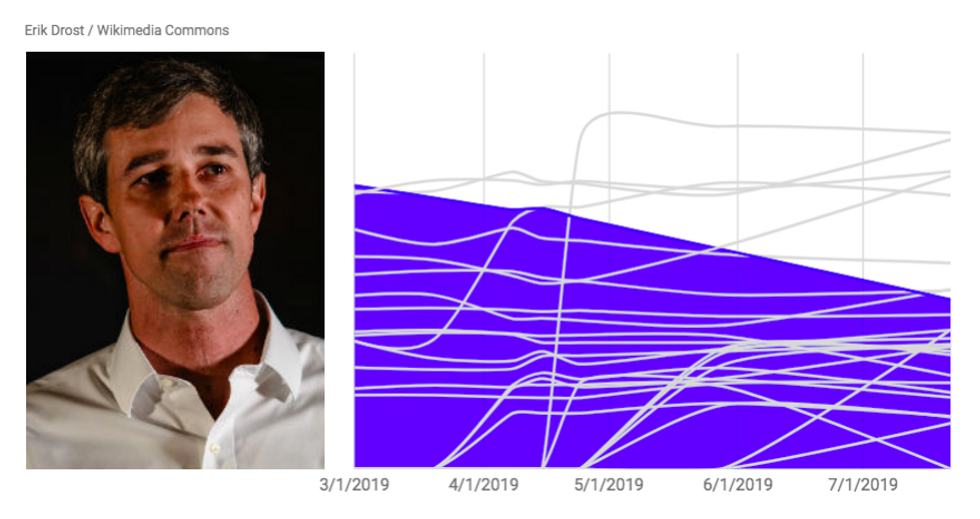
The free fall continues for Betomania.
When campaigns show signs of death, reporters start to write long profiles that aim to tell the story of the demise, or launch the amazing comeback.
Politico's headline (What Beto O'Rourke's Dad Taught Him About Losing) probably wasn't all that helpful.
Beto did secure Willie Nelson's vote though, meaning he can now count on 2 votes, assuming his "Republican" mother votes for him.
Other headlines:
Welcome to America—It's a Hell Hole!
A desperate Beto O'Rourke goes for broke, claims America was founded on white supremacy
Beto O'Rourke finds 'personal connection' to slavery, argues for reparations to unite 'two Americas'
Beto boldly vows not to prosecute people for 'being a human being'Rebooto O'Rourke
Fact Checker: Has Beto O'Rourke visited the most Iowa counties? No.
Beto O'Rourke: Let's Forgive All Student Loan Debt For Teachers
8.Amy Klobuchar 42.9 (Previous: 8th / 41.9) US Senator from Minnesota
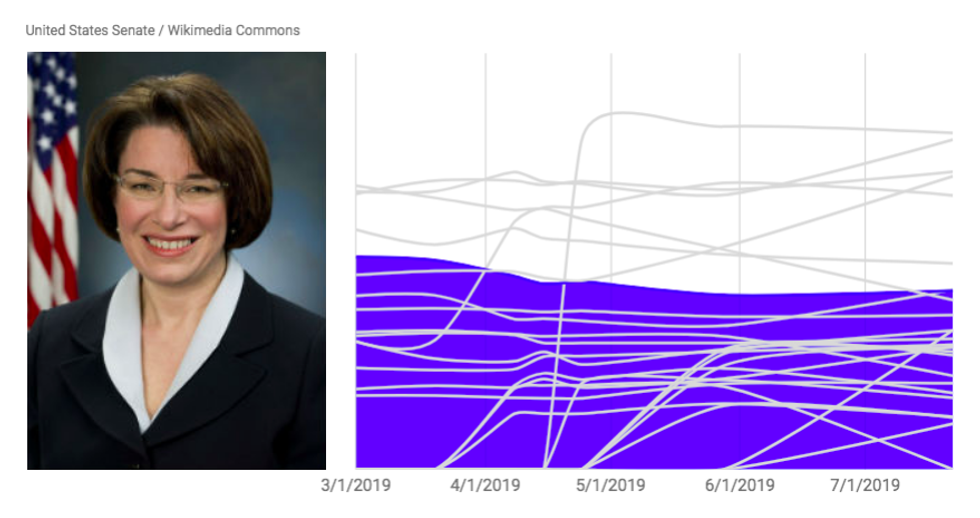
Klobuchar has been a massive underachiever so far, but is still sticking around in that third tier of candidates. Along with Beto, Booker, and maybe Castro— they aren't exactly eliminated, but can't seem to catch fire. Or even get warm.
Klobuchar would serve herself well to focus on the fundamentals and avoiding desperate pleas for attention if she wants to remain in the Biden VP sweepstakes. Or she could totally shake things up by throwing binders at her opponents in the debate.
Other headlines:
Klobuchar: I Don't Support Open Borders Like Warren, Castro
Deportation raids are about distracting from issues: Amy Klobuchar
Klobuchar hoping 'nice' finishes first
Sports bookmakers put Klobuchar as "heavy underdog" in presidential race
7.Julian Castro 43.2 (Previous: 10th / 34.5) Former Secretary of Housing and Urban Development
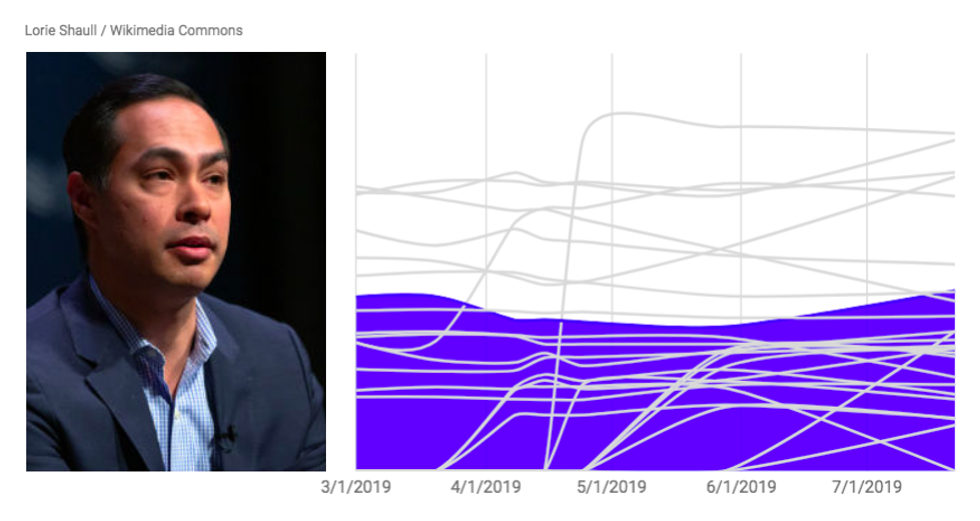
Castro is a good example of how overblown debates can be. His first debate performance was quite solid, but did more to sink Robert Francis O'Rourke than actually help his own candidacy.
One more good debate performance should be enough to get him into the next round of debates, as he has already passed the donor threshold. Polling, however, has been elusive. Perhaps there is a swath of America that is uncomfortable voting for a Castro for president, like say, all of south Florida?
Still, in a field of a zillion candidates that have shown no potential, he stands out as a long shot with a punchers chance to make some noise. This is reflected with a nice bump in his score for this update.
Other headlines:
Julián Castro Doubles Down On Decriminalizing Migration: Repeal Felony For Reentry, Too
Julian Castro: 'Instead of breaking up families, we should break up ICE'
Bill Maher rips Julián Castro for remark about abortion for trans women
Julián Castro declines to hold baby
Julián Castro can't speak Spanish
6.Cory Booker 49.5 (Previous: 7th / 51.6) US Senator from New Jersey
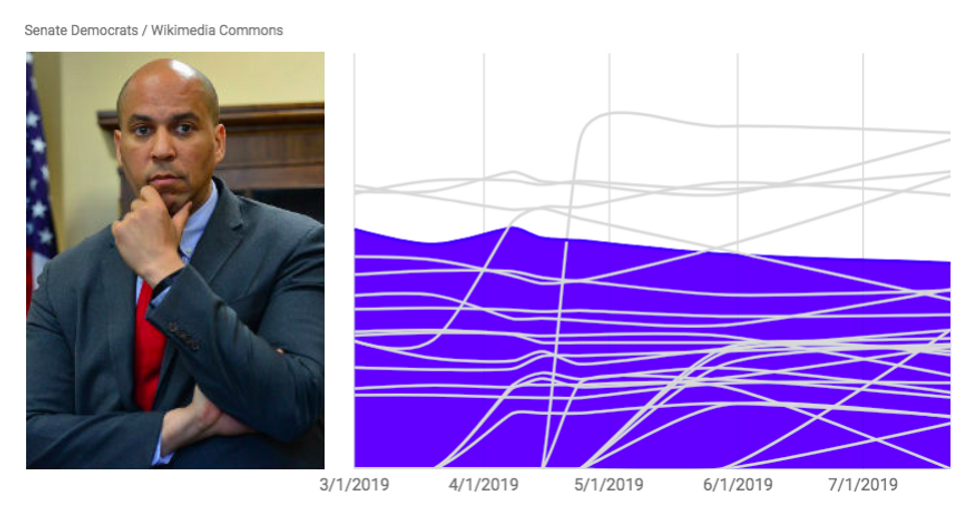
Cory Booker hates the word "realistically." This is supposed to communicate his big picture mindset and ability to strive for the impossible.
Realistically, it's just another cringeworthy try-too-hard moment in a campaign that is notable only for hanging around long enough to show how bad the field is.
Other headlines:
Cory Booker was the only Democrat at the first debate who didn't commit to rejoining the Iran deal
Cory Booker's Brother Got Top N.J. Education Job After Poor Tenure Leading Charter School
Green New Deal and Medicare for All Supporter Cory Booker Says He Hates the Word 'Realistically'
Home means Nevada to Cory Booker
Booker says he uses 'Star Wars' and 'the Force' to make decisions
Pro-Booker super PAC launches black voter push
Cory Booker uses Boston as backdrop to gun platform
5.Pete Buttigieg 65.8 (Previous: 2nd / 68.8) Mayor of South Bend, IN
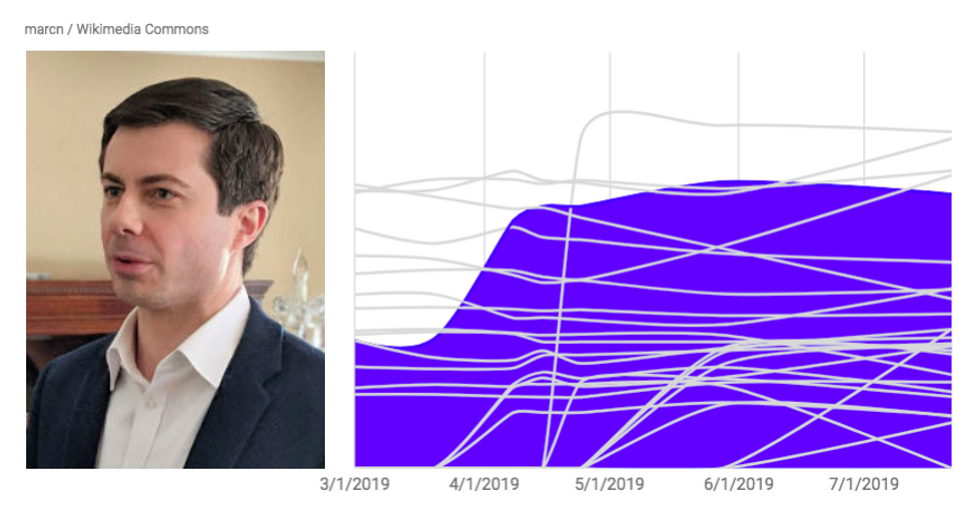
There probably isn't a campaign that has been more bizarre than Mayor Pete. He was a complete nobody to the public, though as we initially noted, he had support from a bunch of Obama era celebrinerds.
This helped him rise to a top tier candidate with all the money and momentum to make a run at the nomination. Since then we've seen a complete fizzle. He is using the cash to build the infrastructure to make himself a serious candidate, and he should last a while, but he probably must win Iowa to have a chance at the nomination.
Also, finding one African American who will vote for him would be nice.
Other headlines:
Pete Buttigieg goes on hiring spree after top fundraising quarter.
Buttigieg, Struggling With Black Voters, Releases Plan to Address Racial Inequities
South Bend police call out Buttigieg for sending pizza rather than apology after race comments
CNN's Axelrod Rips Buttigieg: Blacks Doing Worse Under His Leadership
Only Pete Buttigieg gets standing ovation from Corn Feed audience
New Republic Drops Out Of Climate Forum Over Backlash To Pete Buttigieg Op-Ed
Pete Buttigieg says it's "almost certain" we've had gay presidents
Pete Buttigieg Sets Hollywood Fundraisers With Ellen DeGeneres, Chelsea Handler and More
4.Elizabeth Warren 70.4 (Previous: 5th / 53.4) US Senator from Massachusetts
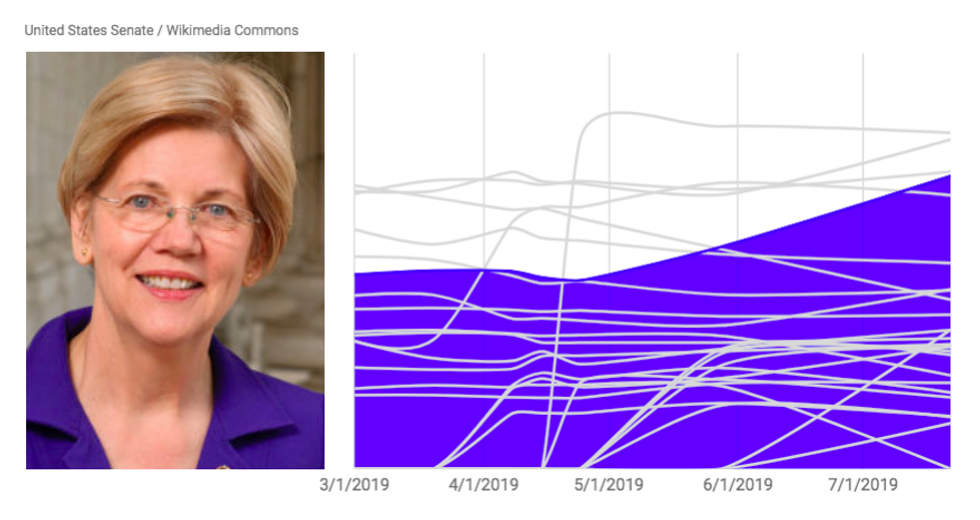
Looking back at my initial analysis of this field, I'd say it's played out pretty closely to what I expected. Warren has surprised me though.
In an election where beating Trump is the most important characteristic for democratic voters, she seems to be grown in a lab to lose to him. She comes across as a stern elementary school principal who would make kids terrified to be called into her office, because she'd bore them to death by reading them the handbook.
Her DNA kit roll out was so catastrophic, I assumed democrats would see that her political instincts are awful. When put under the intense pressure Trump is sure to bring, she's going to collapse, and I figured democrats would recognize that.
Instead, she's in the top tier. This rise has been legitimately impressive for Warren.
It's also a dream come true for Donald Trump.
Other headlines:
The Activist Left Already Knows Who It Wants for President
Netroots Nation was the day Elizabeth Warren became president of the American left
Elizabeth Warren pledges to decriminalize border crossings
Warren plans to increase annual refugee admissions nearly 800 percent from FY2018
Warren, Biden Campaigns Appear to Find Loophole Around Paid Internships
Warren says she'll push to end Israel's 'occupation'
Warren staffer: 'I would totally be friends with Hamas'
Elizabeth Warren reintroduces legislation requiring corporations to disclose climate risk exposure
Elizabeth Warren Wants Reparations For Same-Sex Couples
Elizabeth Warren proposes executive orders to address race and gender pay gap
This is how Elizabeth Warren plans to close the pay gap for women of color
How much would a wealth tax really raise? Dueling economists reflect new split in Democratic Party
Elizabeth Warren Brings Ad Buying In-House
Elizabeth Warren says she raised $19 million in the second quarter of the year
3.Bernie Sanders 71.1 (Previous: 3rd / 67.2) US Senator from Vermont
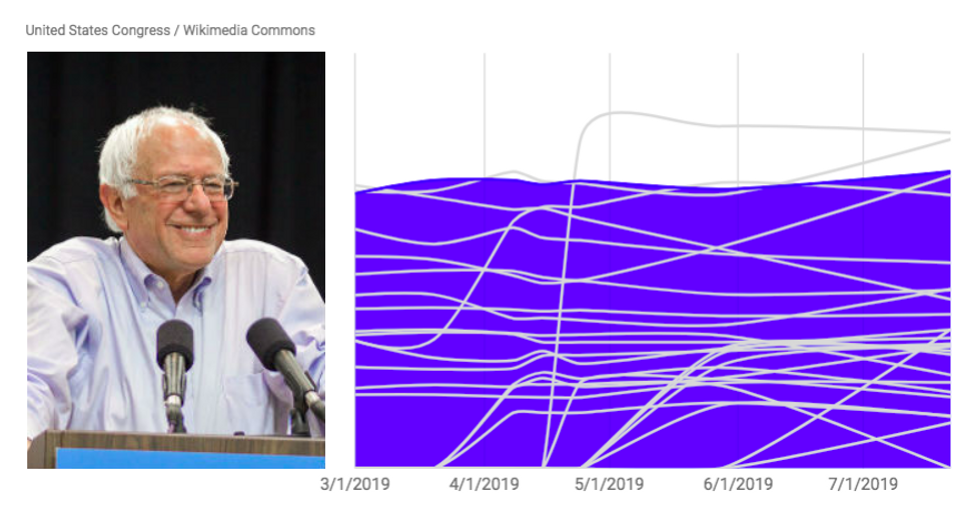
Sanders has fallen slowly but steadily in the polls the past couple of months, and while not every metric yet reflects it, the socialist wing seems more likely represented by Warren.
That being said, Bernie holds her off for third place. Warren and Bernie have reportedly struck a truce to not attack each other, an arrangement which benefits Warren far more than Sanders.
Bernie's machine and name recognition continues to keep him near the top of the heap, but one wonders how long that lasts as name recognition for other candidates get higher, and Iowa gets closer.
No matter if he wins or loses, he's moved the Overton window of the party in a dramatic way. And don't underestimate the appeal of his Medicare-for-all-humankind dream. Bernie may be too old and cranky to see socialized health care into the end zone, but he has advanced that ball much further than he had any right to.
Other headlines:
Bernie Sanders has 'deep sense of satisfaction' his positions are now 'centrist' among Dems
Bernie Sanders: I Will Cancel All $1.6 Trillion Of Your Student Loan Debt
Sanders hits back at Biden over criticism of 'Medicare for All'
Bernie Sanders: Nancy Pelosi shouldn't 'alienate' freshmen House Democrats
Why Sanders Wanted His Meeting With a Rabbi Kept Secret
Bernie Sanders Says Being the First Jewish President Would Be 'Another Barrier Broken Down'
Liberal billionaire calls Bernie Sanders a 'Communist' and 'a disaster zone'
Blackstone's Byron Wien: Markets are terrified of far-left Bernie Sanders and Elizabeth Warren
The time Bernie Sanders ranted about baseball in a low-budget film
Bernie Sanders shows off sword Ross Perot gave him
Bernie Sanders Raises $18 Million in 3 Months, Trailing Buttigieg
2.Kamala Harris 79.2 (Previous: 4th / 65.9) US Senator from California
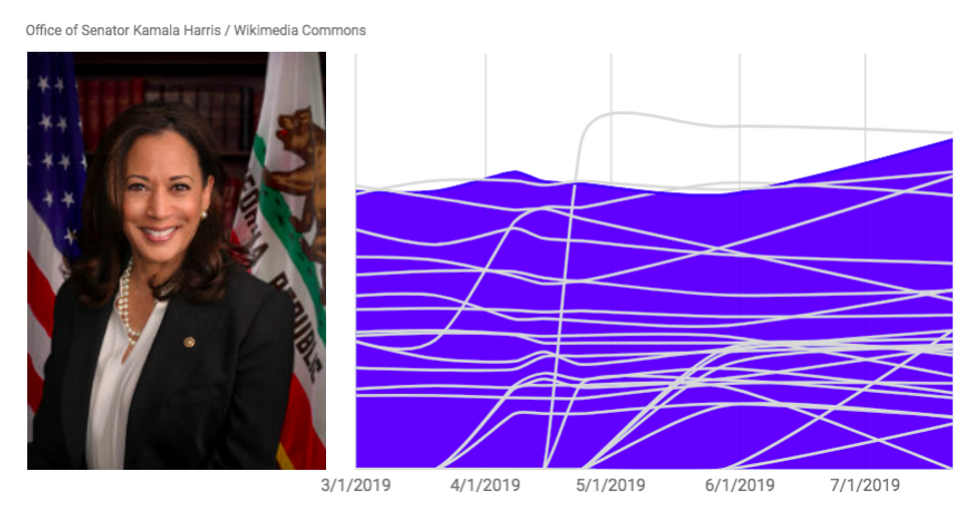
Harris has given back a good chunk of her post debate bounce, which is to be expected. While she rockets to number two in the power rankings, there are a few things to worry about.
The difference between Warren and Harris is notable. The candidates are nearly tied in most polls, but much of the strength of Harris is based on one spectacular moment. Warren alternatively seems to have a lower ceiling, but a stronger foundation.
The good news for Harris is she does incredibly well among voters that are actually paying attention, while her weakness lies with those who haven't really tuned in yet.
At some point, Harris has to clean up her mess of a policy package, which includes supporting a Bernie style Medicare for All without the Bernie style middle class tax hikes-- a combination that even the left admits makes no sense.
Quotes like this still feel way too accurate, "She's the easy-to-listen-to, poorly defined identity candidate." This needs to be sorted out eventually if she's actually going to win.
Other headlines:
Kamala Harris: Immigration Raids Are 'A Crime Against Humanity', there are 'babies in cages'
Harris doubles down on criticism of Biden's busing comments on The View
Mother Jones: Kamala Harris Wants to Bring Back Busing? Really?
Kamala Harris's Call for a Return to Busing Is Bold and Politically Risky
Race is 'America's Achilles' heel,' Harris tells African-American group
Harris proposes $100 billion plan to increase minority homeownership
What's Kamala Harris's record on Israel?
Kamala Harris Called Young People "Stupid" in 2015
Kamala Harris lags behind top-tier candidates in Q2 fundraising
Utah man arrested after alleged scheme to plan fake Kamala Harris fundraiser
1.Joe Biden 80.8 (Previous: 1st / 82.3) Former US Senator from Delaware and Former Vice President
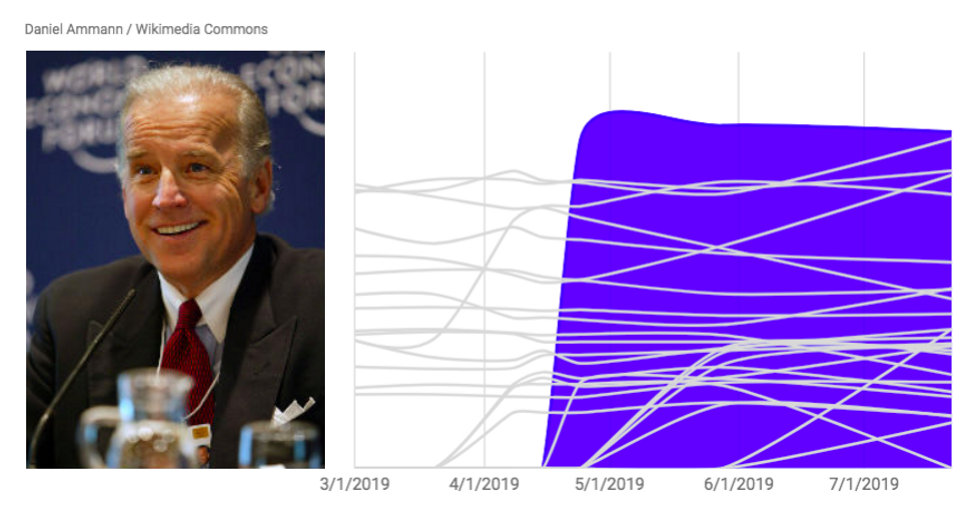
Biden's polling has mostly rebounded to his pre-debate status and he remains the favorite to be the nominee.
He can't survive too many more performances like his first debate however, and he needs to show voters that he can stand up to the heat President Trump is going to bring. In other words, don't get smoked again, fall over on your walker, or look like your dentures are going to fall out in the middle of a debate.
This is a real test for Biden's candidacy. He's had time to prepare, and he's had time to stretch the old muscles. No more excuses.
If Joe can get spry, he probably wins the nomination. But, that is far from a sure thing.
Other headlines:
NBC/WSJ poll: Biden tops 2020 Democratic field...
Joe Biden Decides He Doesn't Need to Stay Above the Fray After All
Biden campaigns as Obamacare's top defender
Biden says Democrats haven't been straightforward about 'Medicare for All'
Biden under fire for mass deportations under Obama
Biden refuses to apologize for high deportation numbers during Obama years
Joe Biden's campaign office opens in Philly with a protest, not a party
Are Biden's Apologies Killing His Electability Argument?
Liberal activists at Netroots Nation bet Joe Biden drops out of race
Joe and Jill Biden have made $15M since leaving White House
How Joe Biden, who called himself 'the poorest man in Congress,' became a multimillionaire
Penn Paid Joe Biden $775,000 to Expand Its "Global Outreach" … and Give Some Speeches
Biden: 'Occupation is a real problem'Joe Biden raised $21.5 million in second quarter, campaign announces
Joe Biden: I Promise To 'End The Forever Wars In Afghanistan And Middle East'
 ALEX WROBLEWSKI / Contributor | Getty Images
 JIM WATSON / Contributor | Getty Images
 Joe Raedle / Staff | Getty Images
 AASHISH KIPHAYET / Contributor | Getty Images