AI is NOT the bubble... the real bubble is jobs. Entire industries are on the verge of disappearing, and college degrees are rapidly losing real-world value as automation accelerates. The next decade is set to erase millions of careers far faster than most Americans are prepared for. Manufacturing continues to collapse, robotics and AI are replacing workers at an unprecedented speed, and a widening disconnect between higher education and economic reality leaves younger generations feeling cut off from the American dream. A deepening generational divide, rising economic hopelessness, and the uncertain future of both white-collar and blue-collar work reveal a reshaped workforce where even trade skills are only temporarily secure. This is the new landscape facing the next generation—and it is arriving much sooner than anyone expected.
Transcript
Below is a rush transcript that may contain errors
GLENN: All right. So we are -- we're just talking about how jobs and AI. That's the bubble that everybody should be talking about. Not the AI bubble. Everybody should be talking about the yobs bubble.
And I think in some ways, everyone in America is. I mean, why?
Honestly, why -- why would you go to college?
I mean, anybody who is sending their kids to college, unless it's for something very specific or you just want, you know, your kid to find themselves. And to, you know, whatever. That is.
Why?
Why are you doing it?
I'm -- I'm begging my kids, trade school. Trade school. Trade school. Trade school. Because that -- that is the job -- those are the jobs of the future. Trade schools. You know, you can be a plumber. I don't know how long that will last. Maybe ten or 15 queers. But that will last longer than let's say truck driver. That will last a lot longer than attorney. Physician's assistant. Well, maybe a physician's assistant. A PA will probably last a while. Nursing will probably last a while.
But doctors -- I mean, it's -- it's -- you don't need as many as we have, right now.
In the future. Because it will be able to be done, robotically.
And I know this sounds crazy, but it's coming! It is come!
Now, we need doctors. So, yes. Go to school for a doctor. But what else?
Why are you going to school? Accounting? Business?
Really? You need that degree.
JASON: I had the same conversation with my son. Exact same.
Doesn't like it. Doesn't even want to talk about it.
STU: It is depressing.
JASON: Yeah, it is depressing, but they completely shut down over anything.
I told him -- I even offered him, I said, I will go to an electrician school with you.
We will do it at night. I was going to do it just to learn another skill.
GLENN: He was confident in the show? No, the sports thing is going to work out, Glenn. The electrician.
JASON: I was actually trying to get around my life screaming at me, the next time I blow the entire circuit in the house. It happened a few times.
GLENN: Sure. Sure. I got it. I got it. You know something I don't know.
JASON: They don't even want to talk about it. These are issues that I'm scared about. It's a complete crazy circle catch-22 situation going on right now. On one hand, the youth are not able to basically survive in the economy right now.
GLENN: They're not able to survive in anything.
JASON: No.
GLENN: In anything. If it's not cooked in a microwave, how many of our kids know how to cook? Even know where food comes from?
JASON: Yeah.
GLENN: I mean, they're not able to survive. You know, I read something about Teddy Roosevelt.
STU: Robotics can definitely do that. Right?
You think, if all this stuff is going away, these jobs are going away, who will need to know how to cook?
This becomes a really depressing conversation. I'm not surprised your son was like, gosh, this sucks. And shuts down. You know what, my -- I have a relative who owns a plumbing business, and he does great. He does awesome.
And it's been incredible for him and his awesome family.
GLENN: Awesome.
STU: That being said, not everybody wants to be a plumber or an legacy. So if what you're --
GLENN: No, I know that.
STU: You're the bad parent in the after school specials. Like, just screw your dreams. Go be a plumber. Who wants to be that guy?
GLENN: Not true. Not true.
My daughter wants to do the absolute impossible. She wants to be an actress. I would love to say, screw your dreams, you're not doing that.
And she talked about going to school, you know. I could go up to, you know, some university up in New York. And I'm like, that's not happening. You want me to pay for it.
Not paying for that. Have a good time. You want to earn it yourself. Go ahead. But I'm not sending you up into that viper's nest.
But I said to her, let's design a school for you. Instead of paying all of this money, let me get private acting classes.
Let me get, you know, private dance classes. It's less than a university. And what you know really got her? Was you then don't have to study all the stuff that you're never, of going to use.
You don't -- you don't -- you don't need to take advanced calculus or anything. Because you're not going to use that. You're never going to use that. You're never going to use that.
Now, my son, he likes math. That's fine with him.
You know, but there are things, when they are driven for something, you don't have to say, be a plumber. You can say, let's find ways for you to learn this in a better way.
STU: Yeah. If you're making a point against the university system, you do not need to sell -- it's like trying to sell me on the Jasmine Crockett candidacy. You have to do no work on that one.
GLENN: Right. Right.
STU: But I do think, it's interesting. I think you're right. I think a lot of these jobs are going to go away. In fact, there are already signs of this.
GLENN: They are.
STU: To the extent of, the back and forth about, you know, tariffs and all this other stuff.
We've seen a decline in manufacturing jobs in this country, this year. A decline. Like, and I don't think that's because tariffs, you know, are shutting down manufacturing anymore than they would have previously.
You know, there's gotten harder arguments about that. But I think more than anything else, people are just taking these jobs offline.
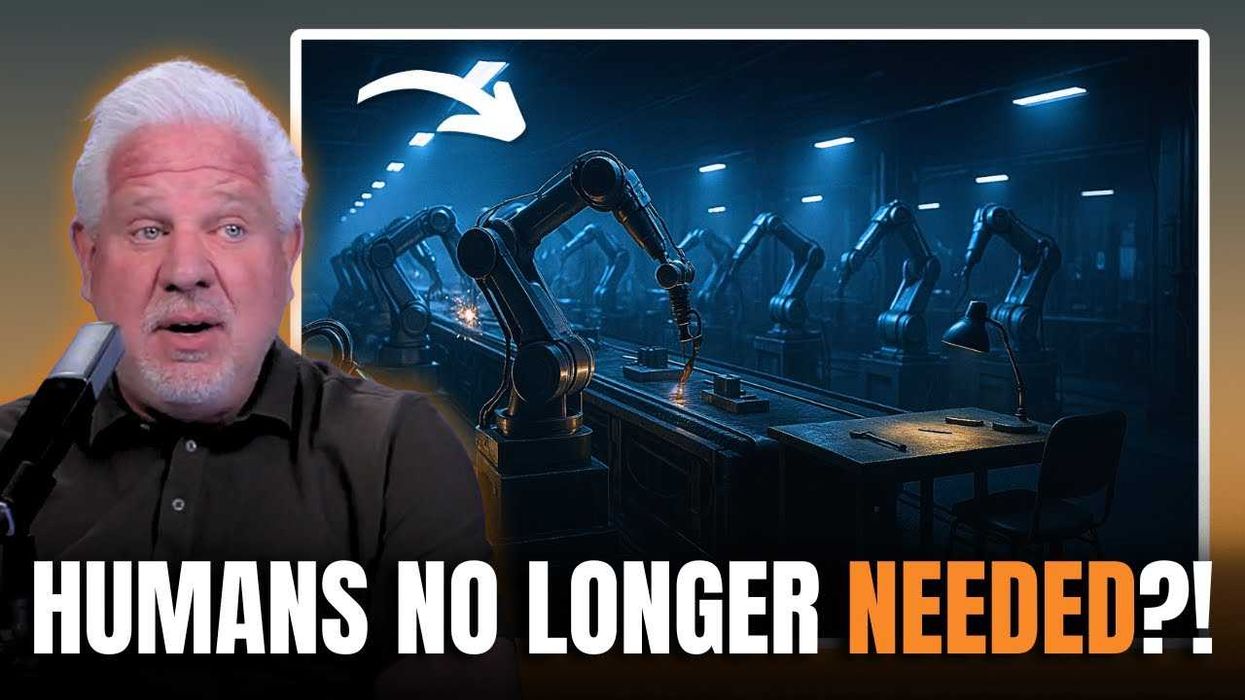
And automating them. All these big companies are replacing thousands of jobs. These announcements are in the news every day.
And it's going to be tough to -- to figure out what the next thing is.
I think you're right. Plumbing and electricians and all these things are going to be very valuable. Particularly in the short to medium term.
It's tough to message that to a kid. Hey. Find this job, that you don't really like. And just do it. It's the only job that exists. It's not exactly an inspiring message.
GLENN: So let me just ask you a question. Because maybe it's me, and what I do.
But I don't think it is.
You know, I'm married into the idea of AI. I have wrestled with it hard. I mean, you know Stu, I've been talking about this since the 1990s. And I've been wrestling with this. Because it is a nuclear weapon, in the hands of every single person.
It's the most dangerous thing man has ever created, and the greatest thing man has ever created, okay?
And so you have to really be careful with it, and have to know how to use it. But, you know, I told -- who was it? Sara, I think I told you yesterday. I said, I am -- I mean, I cried at Kleenex commercials. So, you know, this doesn't mean anything.
But I've gotten emotional using it recently, because there's been stuff inside of me, since I was ten. Things, dreams, ideas that I've always wanted to do. And I'm now being able to not only do those things, but do those things in a way that would have cost me hundreds of thousands of dollars, that would have taken me months to are do.
It was -- just, I couldn't do it. And I'm realizing now, as I'm scratching the surface. I'm learning more about history right now. Because I can grab the resources so fast. I can look into stuff and go, well, that doesn't seem right. And I can go deeper.
What is the difference between doing that, as long as you're using -- you're directing it, and you're using it and checking the sources et cetera, et cetera.
What's that -- what's the difference between that and almost like a book that was written for all the questions that you have?
And because it -- all it's doing, it's taking what you have inside of you.
And following that, is mining for things that will make that stronger.
I've -- I've learned so much history in the last year.
I've learned so much about not just technology, but -- but by -- about my own nature on how I work. What I believe is right. What I believe is wrong.
I mean, I've had this explosion, because I'm using AI every day.
And I don't understand why that's not considered like a university in its own way.
JASON: Can I give you? So you have a perspective of that as a creative.
Think of the amazing things you can do with it. Can I view the perspective of, like, my son's generation?
GLENN: Yeah. Yeah.
JASON: This is what they're thinking. While this sucks, the economy is so screwed, I will never be able to own anything my entire life.
Now, this is what they're telling us, speaking from my son's perspective, but everyone is telling us, don't worry about it, we're going to build, build, build, and we're betting everything on AI. Okay. Great. So it is going to get better, right?
Oh, how many jobs are going to be destroyed? So I can't do that one thing that I wanted to do because of AI? So the solution to why I can't ever take part of the American dream is what's going to eventually take the job that I want to get, so I can some day get the American dream. They're in that circle. And they're like, I'm screwed.
And then you look at the people like Elon Musk, that says, don't worry about it. Because automation, I'm going to be building all these robots. It's going to completely solve world hunger. But wait a minute. I won't have a job.
So none of the math adds up. They're like, wait a minute. And, no. It does. Remember, Stu. We've been talking about this problem for how many years. And I could not get anybody to listen.
I couldn't get anybody to listen.