Renowned Christian author Lee Strobel joins Glenn Beck this Christmas season to discuss the new updated version of his book, "The Case for Christmas." Plus, he dives into the REAL history and facts about the nativity story, including some parts we may have gotten wrong...
Transcript
Below is a rush transcript that may contain errors
GLENN: Lee, welcome to the program. How are you?
LEE: I'm doing great, Glenn. Great to be with you again.
GLENN: Yeah. I love talking to you. I'm really excited to hear the case for Christmas. Now, you were an atheist?
LEE: Yes.
GLENN: And we've talked about this before. Your eyes opened up. And how did you get to the place to where you're like, okay. Let me see if I can make the case for the baby Jesus in the manger?
LEE: Well, yeah, being an atheist. My wife became a Christian. So I decided to try to rescue her from this cult that she had gotten involved in. So that launched me on to an investigation into the historical reliability of Christianity.
I did it that for two years, until I became convinced that in light of the evidence, it would take more faith to become a Christian. So I became a Christian, ended up believing journalism and so forth.
GLENN: Amazing.
LEE: And written many books about it. But I wanted to do a book on Christmas. Because in the Christmas season, there seems to be a more spiritual openness, than any other time of the year.
GLENN: Yeah.
LEE: Even when I was an atheist, I felt more spiritually sensitive during the time of Christmas. I don't know why. I guess because it permeates the culture.
GLENN: Yeah. I think it's because we see hope. We see goodness in one another.
LEE: Yeah.
GLENN: It's different.
LEE: Yes. Exactly. But how do we know if it's based on reality?
How do we know? We can all enjoy the parties and the gift-giving and so forth. But how do we know it's really based on historical reality?
That's what really intrigues me as someone who is a history buff.
GLENN: So take me through that. How do we know?
LEE: Yeah. We have two really early, independent, but consistent reports about the birth of Jesus in Bethlehem 2,000 years ago.
One comes from the Gospel of Luke. Now, Luke, was -- I love this guy. He was an investigative reporter.
There was a companion of St. Paul, and Luke said -- he didn't say, well, I'm going to tell you about something that happened in the distant past once upon a time. No, he said, I carefully investigated everything so I could write an orderly account about the certainty that took place. He's claiming, I'm writing about what actually took place.
I believe he writes from Mary's perspective. I think he may have interviewed Mary. If he didn't, I think he interviews Hosana and Joanna, who were friends with Mary, who he mentions in his gospel. And then we have Matthew. Matthew was also -- he was a disciple. Matthew was -- was right there in the first century setting. He later became a leader in the church of Jerusalem. And one of the other leaders was a guy named James, who was the half brother of Jesus.
So James, I think communicated to Matthew, kind of the male perspective. For the birth of his brother Jesus.
GLENN: Hmm.
LEE: By the way, I was talking to a woman the other take. And she has a young child. I was talking to her about this.
And she said, yeah. If you ask my husband about the birth of my child and you ask me, you will get two different perspectives.
(laughter)
GLENN: Yeah. Yes.
LEE: It's the same birth. We're talking about the real situation.
So we've got this two really early reports. That are independent, that are consistent with each other. And then we have a very interesting report in the gospel of Mark. Now, Mark is writing based on the recollections of Peter, who is one of the inner circle with Jesus.
And he starts his gospel later in life. So he doesn't have a birth narrative. But interestingly, in Mark 6:3. He refers to Jesus as Mary's son. Now, in first century Jewish culture, you would never do that. You were always your father's son. It would have been Joseph's son.
Even if Joseph were already deceased, he would always refer to him as Joseph. And, no. He referred to him as Mary's, and I think there's a wink, that says, yeah, yeah, I know.
Joseph wasn't his biological father. And then we have John, who writes the last gospel.
He doesn't repeat a lot of the historical stuff in the first three gospels. He writes from a grand theological perspective about the incarnation. And with him was the word, and the word was with God. And the word was God.
And then the word came into our world and dwelled among us. So it was very theological. But interestingly, John had a disciple, who he mentored.
And that guy wrote the letter. And in that letter, he says, Jesus was, quote, really and truly born of a virgin. Where did he get that idea?
I think it was from John, who wrote the gospel of John.
GLENN: So is it concerning at all. Because I've heard this argument before. You know, when -- when the gospels all same say the same thing, it's pretty clear. But they can't even decide. They can't even agree on the last words of Christ when he's on the cross.
And is it -- is it -- does it matter. Should we be concerned that only two of the four gospels talk about the birth?
LEE: No. I don't think so. Because first of all, those are two solid sources historically and very early. Mark gives us a reference to the fact that Joseph was not the biological father. And he also portrays Jesus as being the Son of God. And John, of course, was a theological take on the reincarnation. He's basically saying the same thing. So, no. I don't think are a problem. And the differences in the gospels I don't think are a problem either. Because as someone trained in law, if you're in a trial, and the witnesses get up. And they all say the exact same thing, you object. And say, Your Honor, collusion.
They got together, they worked out the story, and you can't trust it.
But when you have different perspectives, people emphasize different things. There's, for instance, a technique that was used in ancient literature, that was used today.
That was called literary spotlight. What that means, somebody will focus on what one person is saying or doing. And other purpose will focus on other people who are involved in the same scene. But it's not contradictory. They're just focusing on different aspects of the same scene. So when you look at what the -- yeah.
GLENN: No. I'm sorry to interrupt. Finish. And then I have a question.
LEE: Sure. When you look at the literary techniques that were used in the first century by (inaudible) and so forth. These historians. And you use those literary techniques in writing the New Testament. These discrepancies between the gospels virtually disappear.
GLENN: So let me take you here: And I believe in the story. So, but I want to push back as hard as I can on this.
LEE: Sure.
GLENN: You know, the virgin birth is so hard for people to accept. And especially once you look at Greek mythology. This is the same story. They're just plagiarizing. This is half man, half God.
LEE: Right. Right.
GLENN: So how do you respond to that?
LEE: Yeah. I actually deal with this in my book. This is totally bogus. This was invented by German theologians in the 1800s. In the early 1900s, the Christians responded to it.
They refuted it. But now, it's come up again. I think as the internet has dredged up these old arguments. For instance, you have the most famous example is Dan Brown in his book and movie the Da Vinci Code. Where he says, oh, well, you know, crusades just copied all this stuff. He said, there was an ancient myth called Mithras. And Mithras was born of a virgin on December of the 25th.
He had 12 disciples. He tied for world peace. He was resurrected from the dead.
So now Jesus is just kind of plagiarizing. The story of Jesus was invented by people and plagiarized from Mithras. Well, I investigate that. And what do you find?
You find in the actual myth of Mithras.
Number one. He was not born of a virgin. The myth was he emerged fully grown, naked, wearing a hat out of a rock.
(laughter)
GLENN: But, I mean, it's the same thing!
LEE: Yeah, I guess you could say the rock is a virgin. But, I mean, secondly, born on December the 25th. So what. We don't know the date Jesus was born. It's not in the Bible, where the ancient records are recorded. Ancient Christians did not care about birthdays. Third, he didn't die for world peace.
He was known for killing a bull. Fourth, he didn't have 12 disciples. According to one version, he had one disciple. According to another version he had two disciples. He wasn't resurrected from the dead. There's nothing in the myth -- it's about him dying. And so nothing about a resurrection. So all of these parallels, supposed parallels disappear when you investigate what actually took place. You know, people say, well, Alexander the great. You know, there was a myth that he was conceived by Zeus.
Well, even Alexander the Great's own mother, Olympias said, it's not true. It's crazy. It's a story. It's not true.
So every one of these supposed myths that predated Christianity, none of them are parallels to the story of Jesus' birth in Bethlehem.
GLENN: All right. Let me take a break, and then I want to take ask you about one word, one Greek word that shed new light on the traditional Christmas story.
More with Lee Strobel here in just a second.
So tell me about the one, the one Greek world that opens things up.
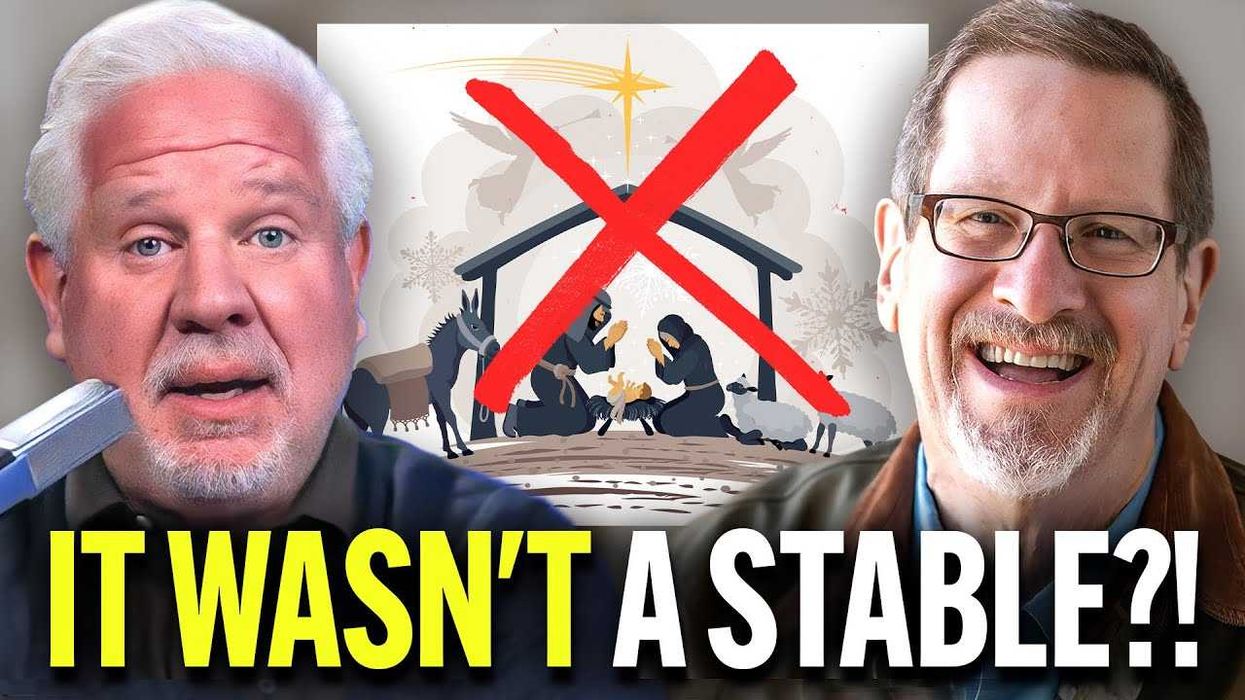
LEE: It really does say he went about the common perception of Christmas. The common idea of Christmas that people have is it's Mary and Joseph because of a census had to go to Bethlehem to register.
And they get there. And she's about to give birth. And they go to a lodge or an inn, and they meet an old entity who says, sorry, no room, dear. And throws the door in her face. So they go off to a stable. And she gives birth among the animals and puts the baby in a manger.
Well, what that comes from. Just a second in the gospel of Luke, where he says, the baby was placed in a manger because there was no room for Mary and Joseph in the katalima.
That's the Greek word. Katalima. So the question is, what does that word mean?
Does it mean an inn? There's no room at the inn? I don't think so. And most scholars don't think so. That's how it was translated in the King James in 1611. But it's probably not the best translation.
So let me explain something. How a house looked in the first century Bethlehem. There was one large room, broken down into two parts. The larger part was the living area.
That that's where people would live, eat, sleep, and then there was a couple of steps bound to a smaller area where the animals were brought at night.
And they were like pets. They may have a couple goats, a couple sheep, and there was a manger there, but because there was a couple of stairs up.
They would sometimes come you up in the living room area. You know, how cute are they?
They're like little lambs, like pets. And so there was a manger also, in the living area. While some of the more wealthy people had a katalima, a guest room. It had a separate entrance. And it made their house bigger.
What apparently happened, is that Mary and Joseph arrived in Bethlehem. And they went to a home of a relative and knocked on the door. They said, hey. We're here for the census. And they said, oh, that's great. But you know what, we have a lot of people here for the census.
There's no room for you in the guest room, the katalima. But you can give birth in the living room. And, yes, there is a manger there, and, yes, some of the animals may have come up the stairs because of the commotion of what was going on. And, yes. There was -- the baby was probably put there in a manger.
Now, in the year 1395, John Wycliffe, who did a translation into English, in the Greek Bible.
GLENN: Right.
LEE: Translated it as a guest room.
The New International version, which is probably the most popular translation in America today, does not use the word "inn." It uses "guest room."
Now, in writing this account, he knew what word to use. Katalima. He uses it one other time. And in that other instance, it was also a room in a house. There's another word he uses, andohayan (phonetic), which is a Greek word that means an inn. And he does use that word when he talks about the parable of the good Samaritan. So he knew, if he wanted to use the word inn, he would have used andohayan, but he didn't. He used katalima.
And the conviction of most scholars, it gives me a guest room. There probably was no inn.
GLENN: Wow.
LEE: Yeah. It's kind of mind-blowing after everything we've heard. And, yeah.
LEE: The other thing is, in first century Jewish culture, the value of hospitality was so high, that -- it would have been impossible for an innkeeper to turn away a pregnant Jewish woman. I mean, he would have been ostracized. He would have been run out of town on a rail. It would have destroyed his business. You could not do that because the value of hospitality was so high.
And we don't even know there were many inns in Bethlehem. It was a small town. Five hundred people. It wasn't on a main crossroads. There may or may not have been an inn there in the first place.
So I think the majority of scholars, I think would agree, that the word really means guest room, and not an inn.
GLENN: That changes everything!
That changes your whole vision of that. You know what I mean?
That's -- that's mind-blowing. That's just totally mind-blowing.
LEE: It is! And not only that, the image we have is that Mary is on the verge of giving birth, as she's arriving. And makes it urgent.
That's not in the text either! It just says that while they were in Bethlehem, she gave birth. It doesn't say they were in Bethlehem five minutes or five days or five months. Now, where the idea, the urgency comes from is the book of fiction that was written in 200 A.D.. A lot afterwards. No real historical connection. In that fictional account, Mary Joseph are approaching Bethlehem, to get 3 miles away from Bethlehem.
And she had to give birth. And so they went into a cave. And she gave birth to some animals in a cave. That's the idea of where a cave come up. Because people to envision her giving birth in a cave. That's really fiction. That doesn't have historical reality written -- you know, way, way later.
GLENN: I have so many questions, Lee. Can I have you back next week?
LEE: Sure!
GLENN: I have so many questions on this. I would love to have you back next week on this.
Because I want to talk to you about the Old Testament. Because people say, well, they just wrote that in later. Because they knew, he was the fulfillment. So they looked, and they just jammed this story together.
But you have the answers to -- to all of that. I would love to have you back next week.
LEE: Absolutely. Just let me know.
GLENN: You've got it. Lee, thank you so much. God bless you. Merry Christmas, we'll talk to you next week. You bet. It's a fascinating book. You've got to read it. The Case for Christmas. It -- while, I mean, you just did. It will turn everything upside down. And I love those kinds of things that make you think and look at things in a new and different way.
Lee Strobel, I think he's one of the best.
He's an author for the case for Christ.
But his new book is the case for Christmas.
How you can know for sure, what was laying in that manger. And where was that manger?
Was it in the kitchen, apparently?
I don't know.